“To build or not to build?” Or more precisely, “To build or to buy?” That is the question that courier companies face when assessing their route optimization software needs.
On paper, the answer seems simple. Building a proprietary solution in-house gives full control and allows unlimited customization. With no monthly subscription fees to pay.
And when you look at dedicated third-party last mile management tools, you may get an impression that building one is easy, as Ryan Thurgood, the Sales Lead at Spoke Dispatch, has seen countless times.
The reality is - it isn't easy. Nor is it faster or cheaper. Not every company has the resources to pull it off. Not in the long run, anyway.
Leaning on Ryan’s years of experience talking to last mile courier companies, we’ll explore the challenges of building bespoke software in-house even for large courier services.
We also explain why choosing an off-the-shelf route optimization tool could be a better decision for most companies and share a framework that will help you choose the right route.
Why does building your own software seem so attractive?
Let’s start by unpacking the main reasons why the idea of building a bespoke route optimization tool in-house is so appealing.
Unlimited customization to your unique needs
Delivery businesses choose to build bespoke software to give them the customization they need. Although in the same industry, different courier companies (or even different depots within the same company) operate in unique ways. Different route optimization philosophies, different driver hiring models, different vehicles, different proof of delivery requirements, different driver scanners… It’s easier to name similarities than all the possible differences.
So, you need a solution that you can easily tailor to your needs. And the assumption is that you can achieve this level of customization only by building your own platform. The reality is that dedicated last mile management software offers high levels of customization, so you get the exact features you need. No need to standardize your processes down and lose the edge.
Complete control over the development process
The second reason for choosing the “build” path is the desire to fully control the development process. By bringing the tool in-house, you can shape its development, timelines, and the user experience it offers. And pivot whenever your needs shift.
However, you lose a lot of that control as soon as you hire an external company to build the software for you. Which many courier companies have to do because they don’t have the necessary resources in-house. Working with external providers adds extra friction, and once the scope is locked (and the contract signed), changing course isn’t so easy.
Full ownership of the software
Once you build the product, you own it. This creates a moat for competitors trying to copy your business model. More importantly, you’re not at the mercy of a third-party software company that may hike prices unexpectedly or sunset features you rely on. Or fold altogether.
Long-term savings
The prospect of long-term savings is a major factor that sways companies towards custom-built solutions. Essentially, building your own tool means you no longer pay subscription fees. But here’s the kicker: many companies underestimate the initial investment needed to get the software up and running.
Worse yet, they fail to consider the ongoing maintenance and licensing costs. And the cost of the missed opportunities to grow their business when their funds are tied up. Consequently, the payback period is longer and the returns are not as high as expected.
The illusion that it’s easy
The illusion that building software is quick and easy is another factor behind the decision to do it. We say “illusion” because it’s far from easy. Ryan sees all the time how even large courier companies don’t appreciate the complexity of the challenge:
“They say we can do that in two or three days. Let's grab the Google API, and we can integrate that. CarryAll [a Hungarian courier company] wanted to achieve their own route optimization tool. And as soon as they got into the nitty-gritty, they realized how difficult it is.”

(learn more about CarryAll's growth journey with Spoke Dispatch here)
What does “build” really mean?
So what’s the “nitty gritty” that Ryan mentions? Let’s have a look at what building your own solution involves.
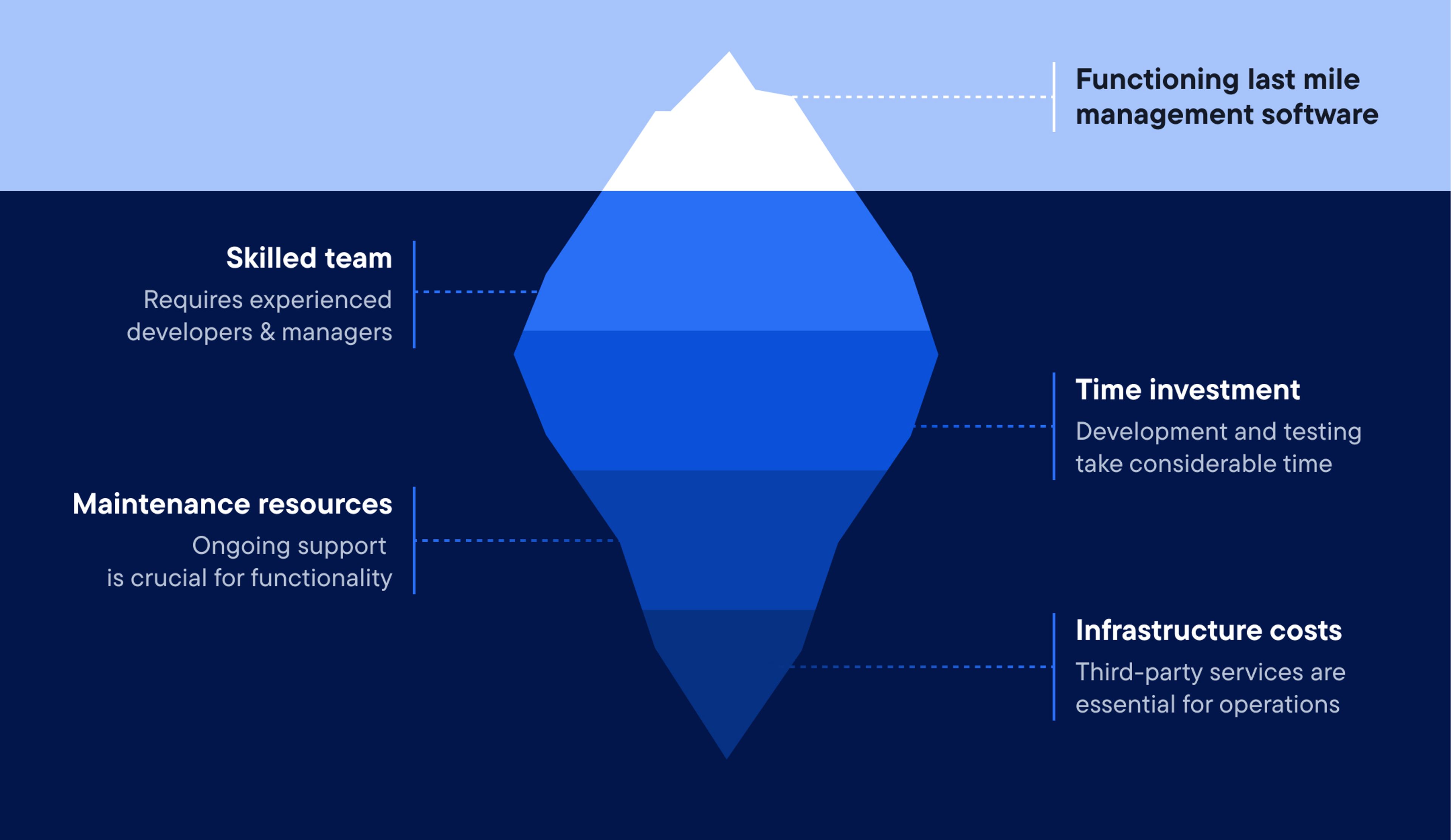
You need a skilled team
For starters, you need a team. A product or a project manager (or both), frontend engineers, backend engineers, QA engineers, Android/iOS engineers, and multiple UX designers for all the interfaces. That’s highly specialized talent. For instance, only developers with very specific (and rare) skill sets can handle complex route optimization algorithms. If you don’t have an internal dev team, you need to build it from scratch or hire a software development company. Which adds to the overheads.
You need 18-24 months to build and test the software
Next, you need time. From Ryan’s experience, anything between 18 and 24 months for development and testing if you’re hiring an external team for the job. Ryan often talks to Spoke customers planning to switch to their in-house solution within 2-3 months who stay for 18+ months:
“They keep telling me that that'll end in the next three months… now it's been a year and a half since they told me they were leaving, and it's still ongoing.”
Jack Underwood, the CEO at Spoke Dispatch, points out that this depends on the personnel you have at your disposal.
He estimates it would take 10 people 2 years to get basic Spoke functionality and a driver app. 25 could do it in a year. To refine the UX, add 6 months. API integrations with your existing tool stack? Another 6 months. An excellent recipient experience? That’s another 6 months.
During the initial 24 months, you’re looking to spend $2-2.5 million on labor costs alone if you’re hiring here in the USA.
You need resources to maintain the custom-built solution
Building the platform is just a start. You need to maintain it. If you don’t, the tool will soon become obsolete and stop meeting your needs, as many companies have experienced:
“Some of the courier company leads I speak to will say, "we built our own route optimization tool 15 years ago, but at this point, we might as well be using pen and paper" because there's no one to maintain the upkeep of the technology.”
To stay fully functional and keep delivering value, your software needs:
- Bug fixes
- Security updates
- Operating system version updates (iOS, Android)
- Map updates
- New features to retain your competitive advantage
- Algorithm refinements
So, you don’t only fork out for the initial development, but also need to factor in the maintenance costs.
You need the infrastructure to run your software
Even if you build the tool in-house, you still rely on 3rd party infrastructure providers to run the software. We’re talking servers, routing clusters, geocoding clusters, and so much more. For instance, using Google Maps data will cost you around $0.04 per stop. More if you want integrated navigation. So, if your drivers make 1,000 stops a month, that’s at least $40 only for mapping.
It’s clear to see that all of these costs can add up fast. Then there’s also the time and maintenance as mentioned. That’s why many courier companies choose off-the-shelf last mile management software.
The issue with many of these plug-and-play last mile softwares is that every courier company works in different ways, and their solutions often have rigid limitations that don’t allow the flexibility couriers need.
Our mantra when building Spoke Dispatch is to offer the flexibility and control that courier companies need to work their way. And we’ve done that, all while offering:
- The easiest and most reliable driver app on the market (check our reviews)
- Synced dispatcher dashboard
- Live tracking for dispatchers and recipients
- Advanced, accurate route optimization
- Barcode scanning
- Client portal for transparency and fast delivery stop uploads
- Flexible proof of delivery
- Dynamic SMS and Email customer notifications
- Custom branding on tracking links, notifications, and all recipient comms
- Multi-depot management
- Many more features built specifically for last mile courier companies
Some couriers struggle to build, some don't
Considering the complexities of software development, building a route optimization tool usually isn’t viable for local courier companies. These couriers and their subcontractors simply don’t have the leverage at this stage of their journey.
Multinational courier companies like DHL, FedEx, or UPS aren’t debating whether to build or buy either. With these household names, even though they aren’t software development companies and as Ryan says, “their expertise lies in delivering parcels, not software,” they do have the in-house resources to build and maintain software. And they’ve already invested in their bespoke last mile solutions.
But for regional or national courier companies, it’s a different story. They rarely have the engineering muscle to build the tool entirely in-house and outsource the initial build. But as they don’t have an internal team to keep it up to date or fix bugs, they have to keep paying external businesses for maintenance. Or let their shiny new software gradually decay.
The TMS trap
One major factor that pushes courier companies down the risky “build” route? Frustration with their Transportation Management Systems (TMS). A TMS manages the broader logistics journey: first-mile pickups, mid-mile transportation between hubs, warehouse inventory, carrier management, and basic customer data.
While essential for overall logistics, legacy TMS platforms, many built 15-20 years ago, fall short for last mile delivery management. Their route optimization capabilities (if they exist) are often basic and can’t handle the complexities of multi-stop deliveries, like live traffic updates, delivery time windows, or driver-specific constraints.
“These TMS’ are about 15–20 years old. And they either don't have route optimization or it's really outdated.” says Ryan. As they weren’t built for a mobile experience, they lack the features that make the difference, like barcode scanning for driver created routes, batch editing routes on-the-fly, proof of delivery capture, or live driver tracking. Facing these limitations, it’s no surprise that a courier company feels it needs a custom-built replacement.
The catch is that modern route optimization tools for couriers, like Spoke Dispatch, aren’t meant to replace the TMS. They’re developed to integrate with it and bridge the gaps in its capabilities.
“We’re designed to work alongside your TMS, and we're not looking to replace it. We're looking to speak with it. So we will handle everything from the moment your last mile deliveries are uploaded to Spoke… until that delivery is made, and we're sending the data back to your TMS…”
When does off-the-shelf last mile management win?
What makes buying a specialized platform like Spoke Dispatch a smarter choice for most courier companies? Here are the main factors.
Speed to value
Unlike the 18-24 month (minimum) timeline for a custom build, implementing a platform like Spoke is fast. Ryan believes you can do it in 10-15 minutes:
“Regional couriers can essentially set Spoke Dispatch up in 10 minutes and get onboarded in that time… I've seen teams do it in 15 minutes.”
Even larger national companies rolling it out in stages can start seeing benefits in specific depots within weeks, not years.
Functionality beyond route optimization
Excellent routing optimization should be standard for last mile management software. To gain a competitive advantage, you need much more. Modern last mile solutions offer advanced features:
- Customer notifications (SMS, email) keep recipients informed and minimize failed deliveries and inquiries.
- Proof of Delivery (photo capture, signatures, or notes) capture helps with verification and dispute resolution.
- Live driver tracking lets dispatchers coordinate deliveries and customers follow their parcels.
- Easy-to-use driver app seamlessly integrate navigation, POD capture, barcode and label scanning, and more.
- Performance analytics to identify efficiency bottlenecks and inform strategic growth decisions
Of course, you can build the features in-house. But as Ryan explains, by the time they’re ready, a dedicated route optimization tool will have rolled out even more features:
“Within those 18 months where a courier has got a base-level route optimization tool that's being built for them, Spoke would have developed rapidly and released new features, so the internal build will always be behind.”
So the "buy for parity, build for competitive advantage" adage doesn’t hold in this context. Instead of giving you the edge, building in-house means playing catch-up with competitors who have adopted a specialist tool that constantly improves.
Continuous maintenance
With a 3rd party platform, there’s no need to worry about bug fixes, security patches, or algo tweaks that drive the development costs.
“We push weekly updates at a minimum, but usually every other day, there are updates to Spoke or Spoke Dispatch.”
Measurable time and cost savings
Implementing an out-of-the-box last mile management software allows courier companies to save time and money on multiple fronts. Here’s one example that Ryan has shared:
“Your driver could wait an additional 30 seconds per stop because no notification was sent out… Let's say they do 60 stops. That's 30 minutes, a significant amount of time… across 10 drivers, it’s 300 minutes, roughly five hours.”
What are some other savings?
- Greater driver productivity (more stops a day, more efficient drop-offs)
- Higher driver retention (thanks to a user-friendly mobile app and realistic workloads)
- Reduced failed deliveries (thanks to notifications and live tracking)
- Lower admin overheads
- Reduced customer complaints (thanks to POD capture customer notifications)
- Lower cost to implement and run (compared to in-house development and maintenance)
Focus on core competency
The Spoke Dispatch team are committed to developing solutions to specific pain points experienced by courier companies. Choosing an off-the-shelf platform with high levels of customization means you can focus on what you do best – managing logistics, drivers, warehouses, new business and existing client relationships.
The courier’s decision framework
By now, regardless of whether it’s build or buy, you already have an idea which path is better for your courier company. However, if you’re still weighing the build vs buy options, Ryan recommends answering these questions.
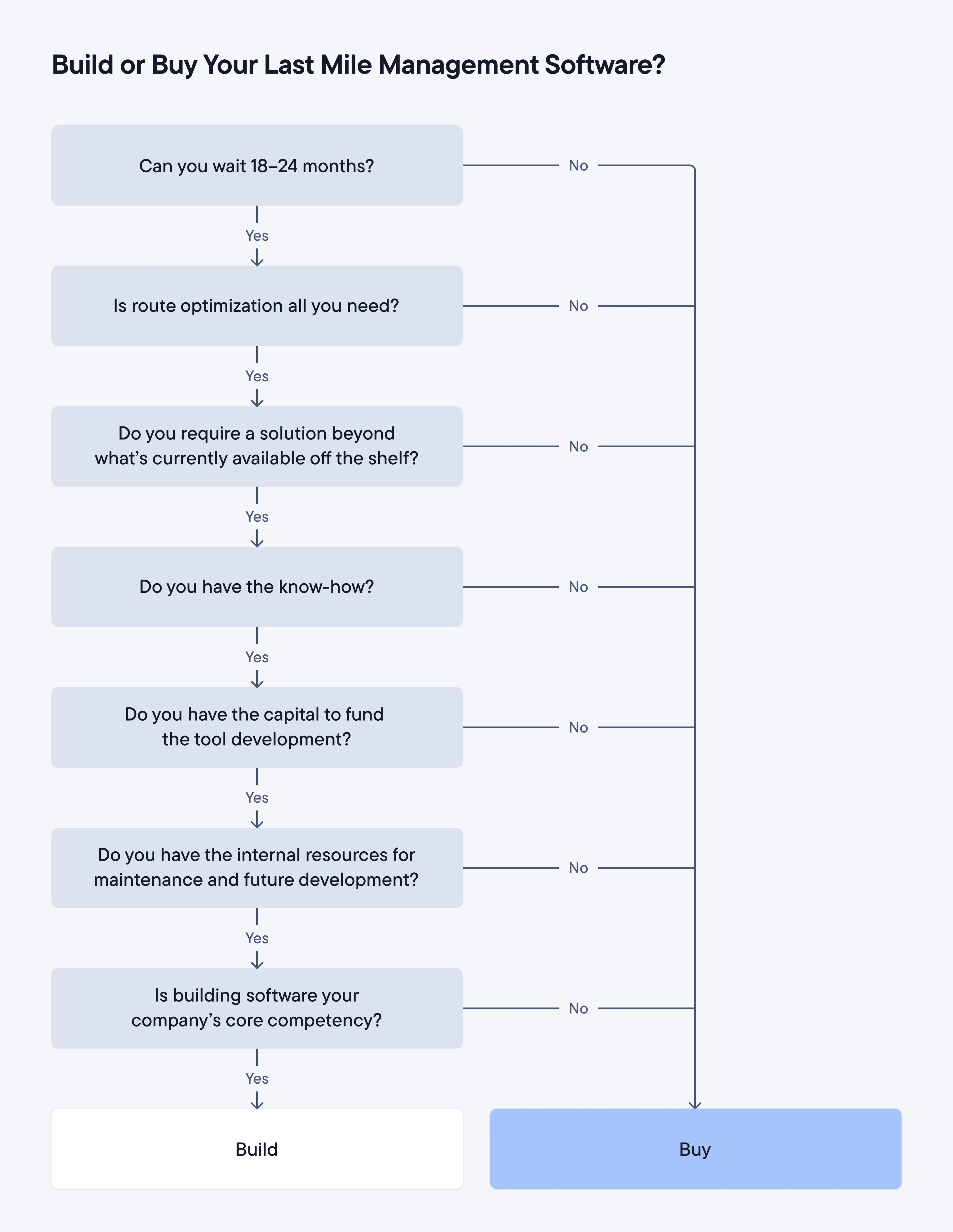
1 - How urgently do you need the software?
The first question is how quickly you need the tool. If you can wait a couple of years for a fully functional solution, building in-house might be a better option, suggests Ryan.
“How quickly do you need it? Do you need it now? Because Spoke Dispatch can work there - but if you're willing to wait two years to be efficient, then maybe it is better to build your own software.”
If inefficiencies are crippling your operations and hitting the bottom line, you don’t have that kind of time, and a 3rd-party tool like Spoke Dispatch is the way to go.
2 - Do you need more than just basic route optimization?
Next, consider the features that you need. Is it just a route optimization tool, or do you also need features like live tracking, SMS or Email notifications, proof of delivery, or seamless integration with other tools via API? Building all these components to the right standard requires more investment and will delay the roll-out even further.
3 - Can the off-the-shelf solution do the job?
Dedicated last mile solutions like Spoke Dispatch are highly customizable, so you can easily integrate them with your existing tech stack. Ryan has worked with a number of companies that chose Spoke as a temporary solution, but eventually terminated their in-house projects because Spoke satisfied all their needs.
“A company will say they’re going to use Spoke Dispatch in the meantime while they build something else. But most of the time, that project never gets finished because they think Spoke is already doing a good job, and there are other areas that they can improve on. Or their focus can now go to what they actually want to do”
However, if you’ve researched the existing solutions and they don’t solve your pain points, then building is the only way to go.
4 - Do you have the know-how?
Another factor to consider is your level of expertise. And the question is not “Can you build the software?” but “Can you do it better than people who live and breathe last mile management software?”
“Do you understand enough about route optimization and all the specifics to build your own tool — in comparison to a company that's eight years old and solely focuses on route optimization?”
5 - Do you have the capital to fund the tool development?
Whether you’re building the team internally or outsourcing it to a specialist software development shop, you need the money to get the project off the ground. And that may be on top of paying for a temporary solution until yours is fully operational.
6 - Do you have the internal resources for development?
If you don’t have the budget or in-house manpower to handle continuous updates and new feature development, an out-of-the-box platform like Spoke Dispatch is probably your best bet. Even if you outsource this aspect, you still need someone internally to manage it.
Couriers should be free to focus on what they do best
Building a custom last mile management platform seems like an obvious solution for courier companies that require customization, control, and functionality that ancient TMS systems don’t deliver. However, it requires considerable investment, not only to build but also to maintain. It can take years, and the results often fail to meet their needs.
Fortunately, the effort is unnecessary. Tools like Spoke Dispatch were built exactly for this reason. They fill the gaps in your TMS functionality without the hassle of building your software. Because as Ryan says, “when you’re a delivery company, you should come to a software company to speak about your software needs.”
If you’re ready to see what fully customizable last mile management software can do for your courier business, why not try Spoke Dispatch for free for 7 days?