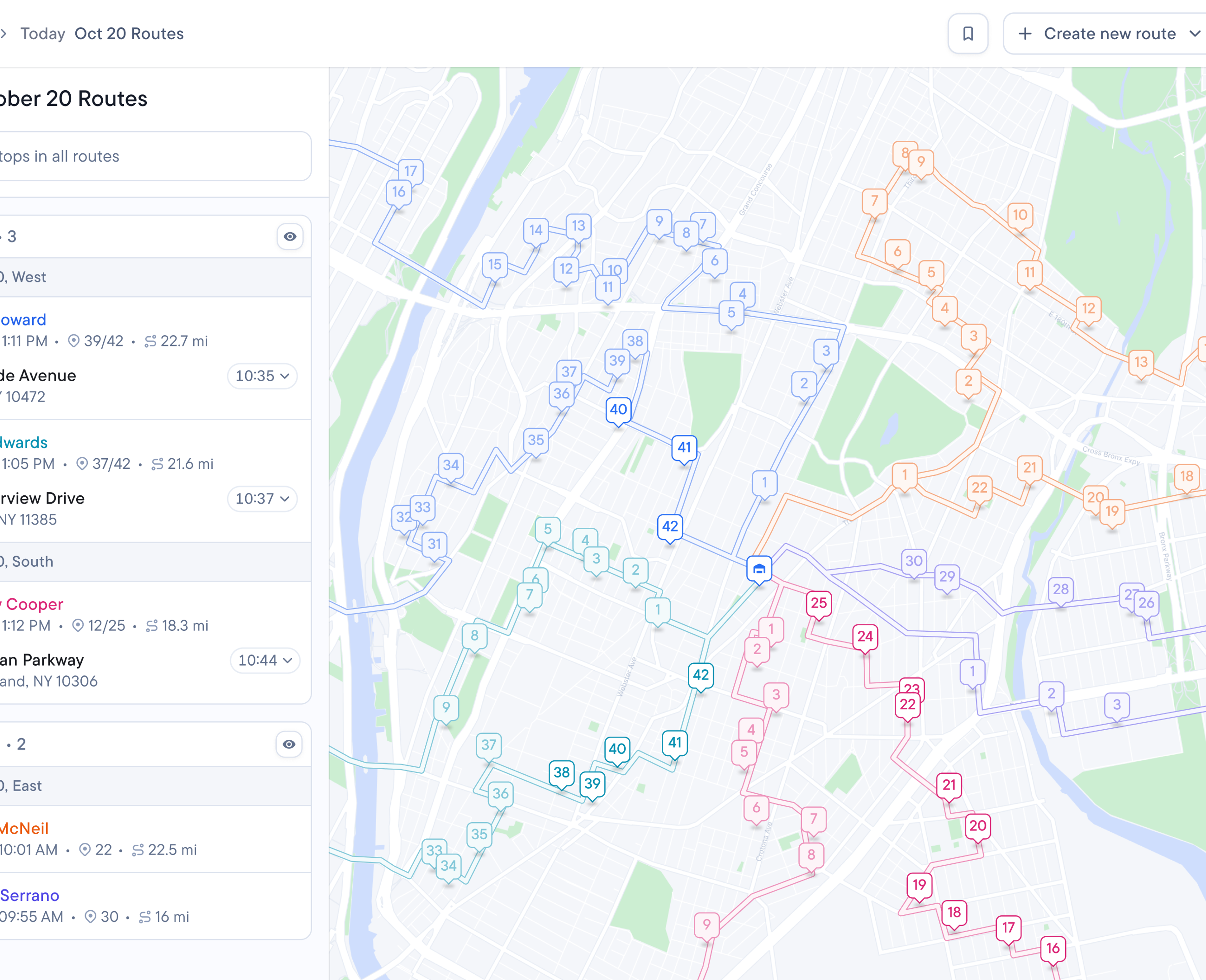
OptimoRoute is a capable route optimizer. It plans efficient routes for couriers, field service teams, pest control companies, pool maintenance crews, and other service businesses. The question is whether a route planner fits how a courier company works - or whether courier operations need multi-shipper workflows that route planners aren't built for.
As a last mile courier grows, the dispatcher's day fills with everything around the route: more shipper accounts, proof that has to stand up in a dispute, and status calls that land on the desk.
The five OptimoRoute alternatives below are evaluated on fit, not rank. Does the tool fit how a courier business runs, or is it a route planner that happens to have courier customers? Spoke wrote this comparison, and Spoke Dispatch is one of the five. We name our own limits alongside everyone else's.
An honest look at OptimoRoute for courier operations
OptimoRoute does the core routing job well. The gaps for couriers come from what sits outside its core. The platform has to work across 16 industries, and the courier workflow that matters most, pickup and delivery in one continuous run, sits behind a Custom-tier sales conversation.
OptimoRoute's strength is route planning for structured, repeatable operations. It handles capacity, driver skills, time windows, and workload balancing across a fleet. Reviewers across several industries praise the time saved on manual route planning. Support gets regular praise. The 30-day trial with no credit card is generous compared with most tools in this set. On Pro, branded notifications and a live tracking page help keep recipients informed.
OptimoRoute is built to serve multiple different industries, but the challenge there is that the features they release need to work for all of them. Courier-specific work sits outside that and requires fit-for-purpose features, such as client portals where each shipper sees its own deliveries, proof-of-delivery rules that differ by client, and custom stop fields for each shipper's own data.
The pricing page tells the same story. Lite starts at $35.10 per driver each month on annual billing, but it leaves out proof of delivery, customer notifications, and analytics. A courier needs Pro at $44.10 per driver each month at minimum. Pickup and delivery in one route is Custom only and still marked BETA on OptimoRoute's pickup page, so reaching it means a sales call.
Capability | Lite | Pro | Custom |
|---|---|---|---|
Route optimization | Included | Included | Included |
Driver app and live tracking | Included | Included | Included |
Proof of delivery | Not included | Included | Included |
Customer notifications | Not included | Included | Included |
Analytics and reporting | Not included | Included | Included |
Pickup and delivery in one route | Not included | Not included | Custom, BETA |
Mid-route depot reloading | Not included | Not included | Custom only |
Phone support | Not included | Not included | Custom only |
A few courier gaps remain even above Pro. Orders cannot be deleted from a live route; there is no native billing or invoicing; and there is no SLA management built for the 2-hour, same-day, and next-day windows couriers commit to.
That does not make OptimoRoute a bad choice. A small courier with simple route planning needs, one main shipper, and light proof expectations may be better served by staying on Pro. The switch makes sense when the dispatcher's day is no longer just route planning.
That is why the alternatives below are not judged on route planning alone. Route quality is the base requirement. The real question is whether the platform also handles the work around the run: order intake, delivery status, proof rules, and the follow-up that still lands on the dispatcher.
The five best OptimoRoute alternatives at a glance
Spoke Dispatch, Onfleet, Track-POD, Routific, and eLogii each fit a different courier operation. The "best for" labels describe the company profile each platform fits best, not a universal ranking.
Platform | Rating | Main strength | Entry pricing | Trial | Best for |
|---|---|---|---|---|---|
Spoke Dispatch | 4.8/5 (100+) | Courier-built; client portal; per-client proof | From $125/mo, per stop | 7 days | Multi-shipper couriers needing ops on top of routing |
Onfleet | 4.7/5 (85+) | Barcode scanning, ID checks, multi-brand | From $619/mo, per task | 14 days | High-volume couriers with regulatory proof needs |
Track-POD | 4.7/5 (140+) | Configurable proof per client, offline capture | From $147/mo or $285/mo | Free, no card | Couriers whose edge is proof quality |
Routific | 4.9/5 (140+) | AI route optimization, unlimited drivers | Free tier; from $150/mo | Free, 100 orders | Small couriers whose main pain is route quality |
eLogii | 4.8/5 (5+) | Route optimization standard, deep config | Custom, est. $359+/mo | Demo | Enterprise couriers running thousands of tasks |
Ratings are Capterra figures. Every tool here clears 4.7, so the question is not whether these products are good. The decision is whether the pricing model and the product fit a courier operation as it grows.
What each platform costs at courier volumes
What you pay depends on how each tool charges. Spoke Dispatch charges per stop, OptimoRoute charges by driver, and Onfleet charges by task. Stop-based pricing fits courier companies because the bill follows deliveries, not headcount. That matters as soon as a courier adds seasonal, part-time, or lighter-route drivers, because a per-driver bill climbs with every hire whether they are busy or not. Per-task pricing sits between the two but usually locks features behind higher tiers.
Platform | Pricing model | ~2,000 stops/mo | ~5,000 stops/mo | ~15,000 stops/mo |
|---|---|---|---|---|
Spoke Dispatch | Per stop, unlimited drivers | $200, Premium | ~$380, Premium | ~$1,210, Expert |
OptimoRoute Pro | Per driver | ~$132, 3 drivers | ~$265, 6 drivers | ~$749, 17 drivers |
Onfleet | Per task, gated by tier | $619, Launch | $1,349, Scale | $3,099, Enterprise |
Track-POD | Per task | $510, M tier | ~$900, L tier | Custom above XL |
Routific | Per order, volume-tiered | ~$300 | ~$630 | ~$1,280 |
eLogii | Per task, custom quote | $359-575 est. | $1,000-2,000 est. | $1,999-3,999 est. |
The numbers above are estimates, not quotes - they show how each pricing model behaves as volume grows. The per-driver row assumes 40 stops per driver per day across 22 working days; a courier running fewer stops per driver needs more drivers and pays more than the row shows. eLogii is quote-only, so its figures are third-party estimates. Pricing was checked against vendor pages, Capterra profiles, and editorial research on May 12, 2026.
Spoke Dispatch, last mile management for multi-shipper couriers
Spoke Dispatch is last mile management software built specifically for courier companies. It is for the dispatcher coordinating drivers and routes across several shipper clients, each with its own delivery rules, terminology, and proof requirements. It replaces the spreadsheets, WhatsApp threads, phone calls, and paper proof that the dispatcher currently juggles to keep every client and driver in sync.
Route quality comes first, because a courier should not trade routing depth for workflow features. Spoke Dispatch plans and optimizes routes around the constraints couriers handle every day:
- Vehicle capacity
- Custom time windows
- First-stop and last-stop priority
- Maximum stops per driver
- Toll-road avoidance
- New volume added during the day
Dispatchers still shape the result. They can batch edit stops, move or copy stops between routes, fix incorrect address points, pin new stops anywhere on the map, and change stop details without re-optimizing the whole route. Spoke Dispatch considers traffic, toll roads, and priority stops when a dispatcher optimizes or re-optimizes, rather than rerouting drivers on its own through the day. Drivers then navigate with Google Maps-powered turn-by-turn directions and real-time traffic alerts.
Route planning is where the work starts, not where it ends. Everything around the route is built in too. Shipper clients upload their own orders through Spoke Connect. Required fields catch missing details before the order lands in your unassigned stop list. Branded SMS and email updates keep recipients informed and cut "where is my order?" calls. Live tracking links help dispatchers answer status questions without calling drivers. Proof of delivery is saved, so it's there when a shipper disputes a drop. It gets harder for a courier when every shipper client wants things done their own way.
The real difference for couriers is configuration per shipper client. A courier serving several shipper clients is effectively running several operations at once, and Spoke Dispatch is built for that:
- Proof of delivery can be set per client
- One client can require a signature plus photo while another allows safe-place delivery
- Each stop is tagged to the client it belongs to
- Custom stop properties can import each client's terminology, such as consignment ID, PO reference, or drop number
- Pickup and delivery can sit in one route
- Delivery zones can be drawn on the map and assigned to specific drivers
- Multiple depots can run from one account with depot-level permissions
- Orders can flow in from client systems through the API or Zapier
That is what separates last mile management from a route tool that happens to serve couriers.
IncaPost, a Sydney courier moving bulky items up to a metric ton for clients such as PedL, runs the multi-shipper workflow through the Spoke Connect client portal. Clients upload their own orders and track deliveries from their own space, which IncaPost reports saves 15 minutes per route on data management and removes the ad hoc client calls that used to land on dispatch, according to its Spoke Connect case study.
KW Delivery shows the onboarding speed. When it won a FedEx subcontract, it subscribed to Spoke Dispatch and began last mile delivery work within 48 hours, according to its Spoke Dispatch case study. The same case study reports it scaled from 50 to 500 deliveries a day.
"On the day we agreed the FedEx contract, I was looking for apps to help my team manage the high-volume routes. Frankly, it would've been disastrous if I hadn't found Spoke."
Every unclear stop is a phone call the dispatcher has to take. Drivers follow Google Maps-powered navigation, scan barcodes when loading, see stop notes and permanent stop IDs, and update delivery status from the route, so wrong-package disputes and hand-assignment requests stop landing on dispatch. A driver app that handles this means fewer calls landing back on dispatch.
Spoke Dispatch has limits. Its footprint is North America plus selected international markets, so broad European or APAC coverage needs a region check. The integration marketplace is smaller than OptimoRoute's or Onfleet's, so ERP or warehouse connections may need API or Zapier work. Spoke Dispatch is built around planned multi-stop dispatch, not same-hour on-demand delivery. It is also not the default for enterprise procurement, advanced compliance, or a deeply bespoke global system.
For a last mile courier with 5+ drivers handling several shipper accounts, Spoke Dispatch is the strongest fit in this set. The deciding factor is not route planning alone. It is route quality plus shipper intake, proof, dispatcher visibility, delivery records, and pricing that does not punish the team for adding drivers.
Onfleet for high-volume regulatory proof
Onfleet is strong last mile software for couriers with enough volume and budget to use it properly. Photo and signature proof are available on Launch. Barcode scanning, ID verification, advanced route optimization, auto-dispatch, and the Operational Command Center sit on Scale. Pricing is task-based, so the bill follows deliveries rather than headcount, and each plan includes unlimited users.
That makes Onfleet a good fit for high-volume couriers with regulatory proof needs, dense delivery flows, and four-figure monthly budgets. It is also broader than courier work, and the Courier Suite add-on brings client portals and invoicing for courier use cases.
The trade-off is cost. Launch starts at $619 per month for 2,500 tasks. Scale starts at $1,349 per month for 5,000 tasks. That is a $730 monthly jump for barcode scanning, auto-dispatch, advanced route optimization, and the Command Center. Courier Suite starts at another $299 per month. Those capabilities can be worth the money, but a 5 to 50 driver courier should know where the bill lands before treating Onfleet as a direct OptimoRoute replacement.
Capterra sentiment is mixed. Reviewers praise how quickly dispatch changes reach drivers; criticism centers on billing governance and account-control issues.
Everything is lightning quick when you make changes - they reflect across all dispatchers and all drivers instantly.
- Capterra review (source)
I remained financially responsible for recurring charges while lacking the permissions necessary to manage the subscription or remove the payment method being charged.
- Capterra review (source)
For a regulated, high-volume courier, Onfleet could be a good fit. For a smaller regional courier, the tier cliffs can arrive before the operation is ready for them.
Track-POD for deep proof-of-delivery control
Track-POD is the proof-of-delivery specialist in this comparison. It fits courier companies whose edge is proof quality across different shipper contracts. A furniture retailer, wine merchant, e-commerce shop, and B2B distributor can each need different evidence at the stop. Track-POD lets teams configure proof rules, capture photos and signatures, scan barcodes, and keep working offline when signal drops.
That makes Track-POD a sensible upgrade when OptimoRoute's proof depth is the weak point. The dispatcher gets cleaner records, and the driver app can collect the proof each shipper expects. Two pricing models, per-driver and per-task, also make it easier to pick the structure that fits the operation.
The limit is that Track-POD is strongest around proof, not the wider courier workflow. A courier still has to think about shipper intake, client visibility, routing depth, and how exceptions move through the day. Capterra sentiment reflects that split.
I have reached out to the customer support twice and requested things that I thought would either not be possible or would take long to implement. In both cases my request was resolved within a few minutes!
- Bastiaan W., Business Analyst, Wholesale (source)
Volume/weight variances vastly reduces automation of daily functions and creates a huge amount of human interaction/workload.
- Capterra review (source)
Track-POD's per-driver plan starts at $147 per month, billed at $49 per driver each month annually with a 3-driver minimum. Its task model starts at $285 per month for 1,500 tasks and reaches $1,440 for 12,000 tasks before custom pricing. It is the right answer when proof is the bottleneck, and less convincing when the core problem is running multi-shipper operations from order intake to client visibility.
Routific for route quality
Routific is the cleanest answer when the pain is route quality. It is a pure route optimizer with AI planning, unlimited drivers and dispatchers, transparent order-based pricing, and the highest Capterra rating in this set at 4.9 of 5 across 144 reviews. The free tier covers 100 orders a month, which makes testing easy for a small team.
That focus is the strength and the ceiling. A courier with one main shipper, simple proof requirements, and drivers crossing paths every morning may get exactly what it needs from Routific. Better routes reduce backtracking, driver confusion, and manual sequencing work.
The ceiling appears when route quality is no longer the only pain. Routific does not give shipper clients a portal for uploading orders and tracking their own deliveries, proof is not built around per-client rules, and deeper courier integrations are limited.
It has taken what I used to spend one day doing and turned it into a 5 minute task.
- Capterra review (source)
Cost to add more vehicles. Sometimes during high traffic times we could use 3 vehicles or more but it's an added feature you need to pay for.
- Capterra review (source)
Routific's paid plan starts at $150 per month for the first 1,000 orders, then adds volume-based overage rates that step down at higher order counts. It is the right choice for route quality first, and the wrong choice when the dispatcher is fighting shipper intake, custom proof, and client status calls.
eLogii for enterprise scale
eLogii is a serious option for enterprise courier operations. Route optimization is part of the standard package, and the product supports real-time tracking, proof of delivery, notifications, barcode scanning, a multi-language driver app, and deep configuration. Reviewers praise support, and the platform can suit companies running thousands of daily tasks with a procurement process.
For a 5 to 50 driver courier, eLogii is usually more system than the business needs. Pricing is custom only, so a smaller operator cannot compare costs without entering a sales cycle. Third-party estimates put entry pricing around $359 to $575 per month, but the exact package and limits need a quote. Reviewers also note that capabilities they expected as standard can sit in higher packages.
That makes eLogii a scale fit, not an obvious OptimoRoute replacement for regional couriers. If the operation has national density, a complex buying process, and enterprise software expectations, include eLogii. If the problem is getting from route planning to better day-to-day courier management, Spoke Dispatch, Track-POD, or Onfleet will usually be easier to evaluate.
How to choose the right OptimoRoute alternative
Start with how your operation actually runs, not the plan pages.. Switching too early can add complexity without fixing the day. If the team still has simple routes, one main shipper, and light proof requirements, the better move may be OptimoRoute Pro and a cleaner process, with a switch later when shipper accounts, proof, or stop volume start to strain.
Operation profile | Best fit | Why |
|---|---|---|
5 to 50 drivers, several shipper clients | Spoke Dispatch | Shipper visibility, dispatcher control, less manual work |
High-volume courier, regulatory proof needs | Onfleet | Handles dense volume and strict proof if budget allows the jumps |
Edge is proof quality across contracts | Track-POD | Proof rules captured at the stop, so disputes aren't about memory |
Main bottleneck is route quality | Routific | The strongest optimizer here, when better routes are all you need |
Enterprise courier, thousands of tasks | eLogii | Built for scale and deep configuration, if procurement can match |
Fewer than 5 drivers, pre-planned routes | Routific free or OptimoRoute Lite | Multi-shipper tooling isn't the pain yet, so don't pay for it |
The question is not which tool is best. It is which tool was built for the operation you run. If that means several shipper accounts, custom proof, and growing stop volume, with a dispatcher who has become the coordination point for everything, Spoke Dispatch is the closest fit in this set. If route quality is the only real pain, a route planner like Routific may be all you need.
How we compared these tools
The comparison covers five platforms with real relevance to courier companies: Spoke Dispatch, Onfleet, Track-POD, Routific, and eLogii. Field service platforms, enterprise orchestration systems, and review directories were excluded because the search intent is OptimoRoute alternatives for courier operations.
Pricing came from public vendor pages, Capterra profiles, and editorial research checked on May 12, 2026. eLogii is shown with third-party estimates because its pricing is quote-only. Competitor review quotes are shown verbatim from Capterra where reviewer identity was available, and summarized where only aggregate review wording was on record. Per-driver and per-task cost bands assume 40 stops per driver per day across 22 working days; actual fleet utilization will vary.
Spoke Dispatch bills per delivery, supports unlimited drivers, and gives courier clients a way to upload orders, track deliveries, and access proof without making the dispatcher the status desk. Try Spoke Dispatch free.
Spoke Dispatch is the best fit for courier companies that need last mile management on top of route quality: shipper intake, proof, tracking, dispatcher visibility, and stop-based pricing. Onfleet fits high-volume couriers with regulatory proof needs. Track-POD fits proof-first operations. Routific fits route quality first. eLogii fits enterprise couriers.
Courier companies switch when the work grows beyond route planning. OptimoRoute is strong at optimization, but pickup and delivery in one route is Custom only, pricing rises with every driver, and courier-specific work such as shipper portals, per-client proof, and SLA management sits outside the core product.
OptimoRoute Lite is $35.10 per driver each month on annual billing, or $39 monthly. Pro is $44.10 per driver each month on annual billing, or $49 monthly. Custom is quote-only. Couriers usually need Pro at minimum because Lite excludes proof of delivery, customer notifications, and analytics.
Not on Lite or Pro. Pickup and delivery in a single route sits on the Custom tier and is still marked BETA on OptimoRoute's pickup-and-delivery page. A courier that runs pickup from shipper depots and delivery to recipients should check this before choosing a plan.
Routific has a free tier for 100 orders a month. OptimoRoute has a 30-day trial but no permanent free plan. Spoke Dispatch has a 7-day trial. Free options work for testing and very small teams, not for a courier already managing several shipper accounts.