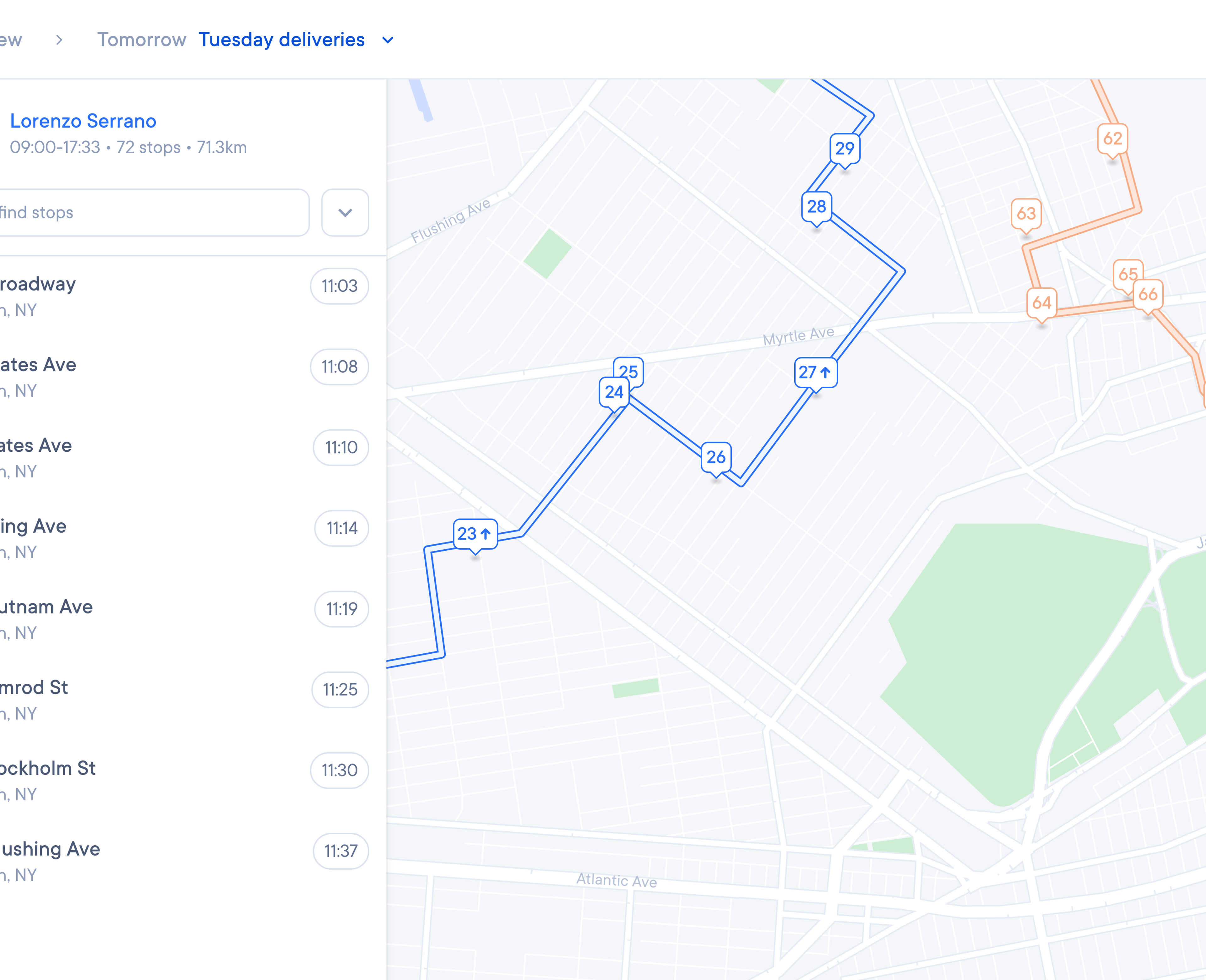
Most courier companies comparing Routific alternatives are not looking for a route planner that can draw a slightly cleaner line on the map. They are looking at what happens around the route. The route gets planned in minutes. The afternoon goes to managing a different proof rule per shipper, answering 'where is order #234?' calls from clients and recipients, and pulling together a different delivery report per client.
That is the line this comparison is built around, and it is a question of business model fit, not company size. Delivering for one business is mostly a routing problem. Selling delivery as a service to multiple shippers is a last mile management problem - the operation that runs on top of and around the route.
This guide names where Routific is still the right answer, then compares five Routific alternatives worth considering when route efficiency is no longer the only thing eating the dispatcher's day: Spoke Dispatch, Onfleet, OptimoRoute, Route4Me, and Track-POD. Spoke publishes this comparison and includes Spoke Dispatch in it, with limitations stated alongside the strengths.
How to read this comparison
Use three questions.
1. Does the platform solve route planning only, or route planning plus the courier workflow around it: proof, client visibility, exceptions, and reporting?
2. Does pricing track what the courier sells - stops or deliveries - or charge for something else, like driver headcount?
3. Can a dispatcher prove, report on, and reconcile work across multiple shipper accounts without stitching it together from spreadsheets and message threads?
Routific appears below as the benchmark you are comparing from, not as one of the five alternatives.
Is Routific good for last mile couriers?
Yes, for the right profile. Routific is a strong route planner, and for some courier operations it is the right tool. Its routing engine builds high quality routes that don’t zig-zag across a territory, handles time windows and vehicle capacity, and lets dispatchers re-optimize routes after dispatch when the day changes.
Routific fits well when:
- Route planning is the main thing you need a tool for.
- You deliver for one client, or several who all have the same requirements.
- Proof requirements look the same at every door, whatever the client.
- Reporting and exceptions stay light enough to handle outside the platform.
Look at who Routific markets to. Food banks, meal prep companies, florists, juice subscriptions, retailers running their own fleet - operations where delivery is a function of one business, not a business in its own right. A courier with one anchor client sits comfortably in that profile, and Routific remains a good fit when proof, exceptions, and reporting are contained enough that the dispatcher can hold them in their head. The five alternatives below matter when that stops being true.
Routific alternatives compared at a glance
The table below compares each platform against the three questions above. Read the "Courier workflow depth" and "Pricing model" columns together. That is where business model fit usually shows up.
Platform | Best for | Routing strength | Courier workflow depth | Pricing model |
|---|---|---|---|---|
Spoke Dispatch | Multi-shipper couriers needing per-client customization | Google Maps partnership with capacity, custom zones, and priority stops | Configurable proof per client, client portal, custom properties, exports | Stop-based, unlimited drivers on every plan |
Routific (benchmark) | Couriers with one anchor client where route efficiency is the bottleneck | Strong route optimization with time windows, capacity, and live traffic | Limited once proof, client visibility, and reporting live around the route | Order-based, with a free tier and volume discounts |
Onfleet | Multi-category delivery teams covering grocery, retail, courier, and more | Predictive ETAs, geofencing, and vehicle-type routing | Strong delivery management; courier work via separate Courier Suite | Task-based, tiered, with courier add-ons to evaluate |
OptimoRoute | Small teams with stable driver rosters and uniform delivery requirements | Strong route optimization, scheduling, and workload balancing | Strong scheduling and reporting; no client portal or per-client config | Per-driver |
Route4Me | Multi-industry teams with time to evaluate packages and add-ons | Multi-driver optimization with territory and clustering tools | Depends heavily on package and add-on configuration | Contact-sales package pricing |
Track-POD | Teams whose main pain is proof depth | Routing available, but secondary to proof capture | Deep proof-of-delivery tooling; lighter on multi-client dispatch workflow | Per-driver or per-order |
Pricing comparison at courier volumes
Each platform in this comparison bills on a different unit. It’s important to pick one that matches how you bill your own clients.
- Order-based (Routific): you pay only for the orders you schedule. No orders booked, no charge.
- Stop-based (Spoke Dispatch): pay per delivery stop. Costs follow completed work, not driver roster size. Drivers and dashboard members are unlimited on every plan.
- Per-driver (OptimoRoute, Track-POD): pay per driver on the roster, busy month or quiet. Seasonal drivers and contractors move the cost up regardless of how much they earn.
- Task-based packages (Onfleet): pay for a tiered task allowance. Watch the included volume, add-ons, and whether courier features sit in the base plan or in a paid module like Courier Suite.
The cheapest base plan isn't the cheapest tool if the operation needs a higher tier, an add-on module, or a second tool to handle proof and reconciliation.
For couriers specifically, stop-based pricing has a structural advantage: you earn per delivery, you pay per delivery. The software cost moves with the work completed, not with how many drivers are on the roster, how many users sit in the dashboard, or which add-on package you bought. A quiet month means a lower bill. A seasonal peak does not push your platform cost up alongside it.
Here's how each platform handles a real courier workload, starting with Spoke Dispatch.
Spoke Dispatch: last mile management for multi-shipper couriers
Spoke Dispatch is last mile management for courier companies serving multiple shipper accounts, built for the courier workflow rather than bent to fit it. Smart route planning still sits at the core, but the management layer around it replaces the messy spreadsheets, manual processes, constant WISMO calls and shared folders. It fits when that work, not the route, has become the dispatcher's day.
Route quality still comes first. Spoke Dispatch plans routes around vehicle capacity, custom time windows, first and last priority stops, delivery zones drawn on the map, and address points that need fixing before drivers leave the depot. When new stops arrive mid-route, the dispatcher can re-optimize and push the edit to the driver instead of rebuilding the day in a separate tool.
What changes for a courier is everything that happens around that route. Spoke Dispatch keeps order intake, live tracking, customer notifications, proof of delivery, and exportable stop data in one workflow, so delivery status, proof, and billing evidence do not end up in three different places.
Picture a 60-stop morning split across three shipper accounts:
- Shipper A wants a signature and photo at every door.
- Shipper B wants a barcode scan and the recipient's name.
- Shipper C wants an extra order reference because its invoice team matches every delivery back to an internal order.
On a routing-only tool, the dispatcher carries those rules in a per-stop note, drivers send proof to the dispatcher through a messaging app when the standard capture does not fit, and someone files the evidence into a shared drive at the end of the day.
It works until a dispute lands. Shipper B says Tuesday's delivery never happened. The dispatcher has a route marked complete and a photo from the driver, but no barcode scan tied to that stop and no timestamp the shipper will accept. Ninety minutes go into reconstructing the stop, and the shipper docks the invoice anyway because the evidence was not on the platform.
Spoke Dispatch carries each shipper's proof rules into the driver's flow. Configurable POD collection lets a courier set what proof is required per client. Signature capture, photo capture, and barcode scanning handle the proof itself. Proof-of-custody timestamps record custody events when package barcodes are scanned. Spoke Dispatch records GPS coordinates and a timestamp when a stop is marked delivered.
The same per-client customization applies on the shipper’s side as well. Required fields in Spoke Connect stop clients from importing incomplete orders, and custom stop properties carry client-specific details, like that internal order reference, onto the stop record. Customizable exports then pull stop and proof data out for billing reconciliation instead of leaving the dispatcher to collect evidence from one folder per shipper.
The courier-company outcome is the part that matters. Disputes resolve faster because the proof is tied to the stop, the dispatcher stops being the per-shipper rules engine, and month-end reconciliation runs off cleaner exportable data. RoadRunner, a Spoke Dispatch customer, describes the gap this closes:
"Lots of clients are still very old school in terms of their tech systems. No ETAs, no ability to track the drivers. POD that they can't access for hours or even until the next day! It's just old and clunky, so by using Spoke Dispatch, we definitely have the advantage."

The quote works because it names the operating failure behind modern delivery tracking: clients cannot see the ETA, cannot track the driver, and cannot access POD fast enough to manage their own customer or internal team. For a courier, that gap becomes an operational ownership problem rather than a tracking feature gap. That is the layer a courier workflow has to own once the business serves multiple shippers.
Spoke Dispatch is not the right answer for every reader of this page. If routing is still the only meaningful bottleneck, this is more platform than the job needs. Its integration marketplace is smaller than the largest delivery-management incumbents, so a team that depends on a long list of pre-built connectors should check coverage before switching. Same-hour, customer-initiated dispatch is not the operating model Spoke is built for. The pricing also assumes stop volume is a fair proxy for what the courier does, which is true for parcel couriers and less true for operations with very few, very high-value stops.
That limitation matters because the Spoke case should not be reduced to "more features." A route-only courier does not need more workflow surface area just because it exists. The stronger Spoke fit appears when separate proof rules, client access, exception evidence, and billing data are already creating manual work. In that setting, the extra system becomes the place where the dispatcher moves work that otherwise lives in notes, messages, folders, and memory. The buyer's job is to decide whether that work is already painful enough to belong in the platform.
Onfleet
Onfleet is an established delivery-management platform, and for a broad delivery operation it is a credible choice. It runs mature delivery management with routing, tracking, proof of delivery, notifications, API and webhook access, and a branded tracking experience. For a courier evaluating it as a Routific alternative, Onfleet is clearly good software. The sharper question is where multi-shipper account work lives inside the product.
Onfleet serves many delivery categories, including grocery, pharmacy, restaurant, retail, and courier delivery. That breadth is useful when a company wants one delivery platform across several service lines. It also means a courier needs to validate whether the client portal, rate tables, invoicing, proof requirements, and courier-specific workflows fit the full package it is buying, not only the base platform.
For a courier company, the practical test is specific. Can the team manage different shipper accounts with different proof rules? Can clients see the right delivery information without calling dispatch? Can proof and status data support billing and disputes? If those workflows require add-ons or package upgrades, the buyer needs the total platform cost before comparing Onfleet with Routific or Spoke.
That is where Onfleet demos need to get concrete. A courier should ask to see the exact client workflow, not only the dispatcher map: how a shipper views delivery status, how proof is exposed, what happens when a stop is disputed, and where invoicing or rate-table work lives. If the answer depends on a paid add-on, a custom configuration, or a higher tier, that should be part of the comparison from the start.
Onfleet can work well for broad delivery teams that want a mature delivery platform and are comfortable validating package fit. It is less clean as a Routific replacement when the buyer specifically needs courier workflow depth around multiple shipper accounts and wants that model to be the center of the product.
OptimoRoute
OptimoRoute is a strong horizontal route optimizer. For a small, route-efficiency-led team it is one of the clearer ways to plan good routes. It handles scheduling, workload balancing, live tracking, and planned-versus-actual reporting, and it fits a wide range of delivery and field-service operations.
That makes OptimoRoute useful when the dispatcher wants better sequencing, a stable planning workflow, and a cost model tied to a predictable roster. A courier with a fixed driver team, uniform delivery requirements, and low variation between shipper accounts can get strong routing value without buying a heavier courier operations platform.
The boundary is the same shape as Routific's, drawn at a slightly different place. Route efficiency can be solved while multi-shipper proof, client visibility, and billing reconciliation stay outside the workflow. OptimoRoute's per-driver model also changes the growth math. A courier that adds seasonal drivers, part-time drivers, or contractor coverage may see software cost move with roster size rather than completed delivery work.
That distinction is manageable for the right buyer. Compare OptimoRoute against driver roster stability, not only monthly stop volume. Route planning still matters here, and OptimoRoute does it well. The gap is the courier workflow that has to run around the route once the business serves several shipper accounts with different requirements.
In a trial, assume OptimoRoute can produce a better route than the current process. The test is whether the dispatcher still needs a second workflow for client-specific proof, status requests, dispute evidence, and billing data once the route is complete. If those jobs stay outside the platform, OptimoRoute may still be a good route planner without being the right courier operations system.
If OptimoRoute is already on the shortlist, our deeper look at OptimoRoute alternatives covers where it fits and where it falls short for courier work
Route4Me
Route4Me is built for breadth. It serves delivery, field service, sales, pest control, waste management, and other route-heavy operations, with capable multi-driver optimization, territory management, and geographic clustering. For a courier that wants configurable routing and has the time to evaluate packages, add-ons, and operational requirements in detail, that flexibility is real.
The cost of that breadth is evaluation effort. A courier company has to work out which package covers the route work, which add-ons matter, how customer notifications and proof workflows behave, and whether courier-specific client visibility or billing data is native enough for the way the business runs. If the team needs SMS, geofencing, or other add-on capabilities, the pricing model can be hard to compare without a detailed package review.
Route4Me can make sense when routing configurability across several operating models is the priority. It is a weaker fit when the courier company wants the buying decision to start with courier workflows: shipper-specific requirements, stop-level proof, client visibility, and the evidence trail needed to resolve disputes and invoice cleanly.
The buying motion should reflect that. A courier evaluating Route4Me should not stop at "Can it optimize our routes?" It should ask for the exact package and add-ons needed to handle a normal courier day: imported stops from different clients, different proof requirements, driver execution, customer notifications, exception handling, and the export or report used when a client questions a delivery. If the answer is spread across several modules, the comparison should include that setup and management cost.
Track-POD
Track-POD comes at delivery from the proof side. It is strongest when the single sharpest pain is proof of delivery: capturing evidence cleanly, presenting it quickly, and giving the operation a better record when a recipient or shipper questions a completed stop.
For a courier moving away from paper-based proof or a simple routing tool, that proof depth can matter. Track-POD is a more proof-focused tool than Routific. It can make sense when routing is not the biggest issue and the buyer mainly needs stronger POD documents, photo capture, signatures, and proof reporting.
Where Track-POD sits apart from the multi-shipper courier model is the rest of the workflow. Proof depth is not the same as full courier workflow depth. A courier serving several shipper accounts still needs to ask how client visibility works, whether proof requirements can vary by shipper, whether stop data supports billing reconciliation, and whether the pricing model fits the way the operation scales.
Track-POD is a useful Routific alternative when proof capture is the primary gap. It is less convincing when proof is only one part of a wider client-visibility, exception, and billing workflow.
The demo question is simple: after a disputed stop, who has to reconstruct the evidence? If Track-POD gives the dispatcher the linked proof, timestamp, and document the shipper needs, and the rest of the courier workflow is simple, the fit may be strong. If the dispute also needs client-specific data, portal access, billing context, and a clean export back to the shipper account, proof capture alone may not be enough.
How to choose the right Routific alternative
Start with one question: what is eating the dispatcher's day?
- Route efficiency is still the main bottleneck, the courier serves one anchor client or several clients with uniform requirements, and proof and billing are contained: stay on Routific. If route quality is the whole job, compare Routific against route planning built for courier companies before deciding
- The courier serves multiple shipper accounts with different proof, visibility, exception, and billing needs, and the dispatcher's day is filling with proof reconstruction, status calls, and reconciliation: choose Spoke Dispatch.
- The operation runs broad delivery across several markets and can validate courier add-ons, package fit, and total cost: choose Onfleet.
- The team wants strong route optimization for a predictable roster and proof or billing complexity is low: choose OptimoRoute.
- The team needs configurable, multi-industry routing and has the resources to evaluate and manage packages and add-ons: choose Route4Me.
- The single sharpest pain is proof depth rather than multi-client dispatch: choose Track-POD.
If the honest answer is the second one, where business model fit has moved the bottleneck past routing alone, Spoke Dispatch is built for that operating model. Run a real route through it: upload stops, apply client requirements, route the day, capture proof, resolve exceptions, and export the data the business needs afterward.
That trial route should include the messy parts of the business, not a clean demo day. Use stops from more than one shipper. Include at least one stop with required proof, one stop with a missing or incorrect field, one exception, and one export that finance or a client would use later. A route planner can look good on an ideal day. A courier operations system has to hold up when the dispatcher needs the route, the proof, the client view, and the billing record to agree.
The best alternative depends on the bottleneck. For couriers serving multiple shipper accounts with different proof, visibility, and billing needs, Spoke Dispatch is the strongest fit because it keeps route planning core and adds the workflow layer around it. For a small, route-efficiency-led team, OptimoRoute or staying on Routific may be closer.
Yes, for the right profile. Routific is a strong route planner and fits couriers with one anchor client or uniform requirements, where route efficiency is the main bottleneck and proof, exceptions, and billing are still contained. It does less well once those workflows have to run per shipper.
Stay on Routific when route efficiency is the bottleneck worth solving, shipper requirements are simple and consistent, and proof, exceptions, and billing have not started eating the dispatcher's day. Routific's order-based model can also suit variable delivery volume.
Route planning builds efficient driver sequences. Last mile management adds the workflow around the route: proof per client, client visibility, exception handling, and billing data across shipper accounts. Courier companies need both. Route planners solve the first problem.
No. Spoke Dispatch includes route planning and adds last mile management around it. The point is not that route planning stops mattering. The point is that courier companies often need routing, proof, visibility, and stop data in one workflow.
For a small, route-efficiency-led team, OptimoRoute and Routific itself are usually the closest fit. Watch per-driver pricing on OptimoRoute as the roster grows, and reassess when proof or multi-client billing complexity appears.