
The last mile got harder, and it all lands on the dispatcher. Routes to plan for the day. Drivers asking where to leave a parcel. Clients asking where their parcel is. Recipients who missed the knock. Proof that a drop happened. Exceptions when it did not. Most of that work still lives in spreadsheets, WhatsApp threads, phone calls, a scanner app, paper proof, and a different workaround for every client. Online shopping pushed the volume up, and the patchwork stopped keeping pace.
So the dispatcher becomes the thing holding it together. They are the link between six tools that don’t talk to each other, while making sure the spreadsheet, the messages, and the clients are all aligned. Last mile management is the discipline that removes the chaos and puts the dispatcher back in control.
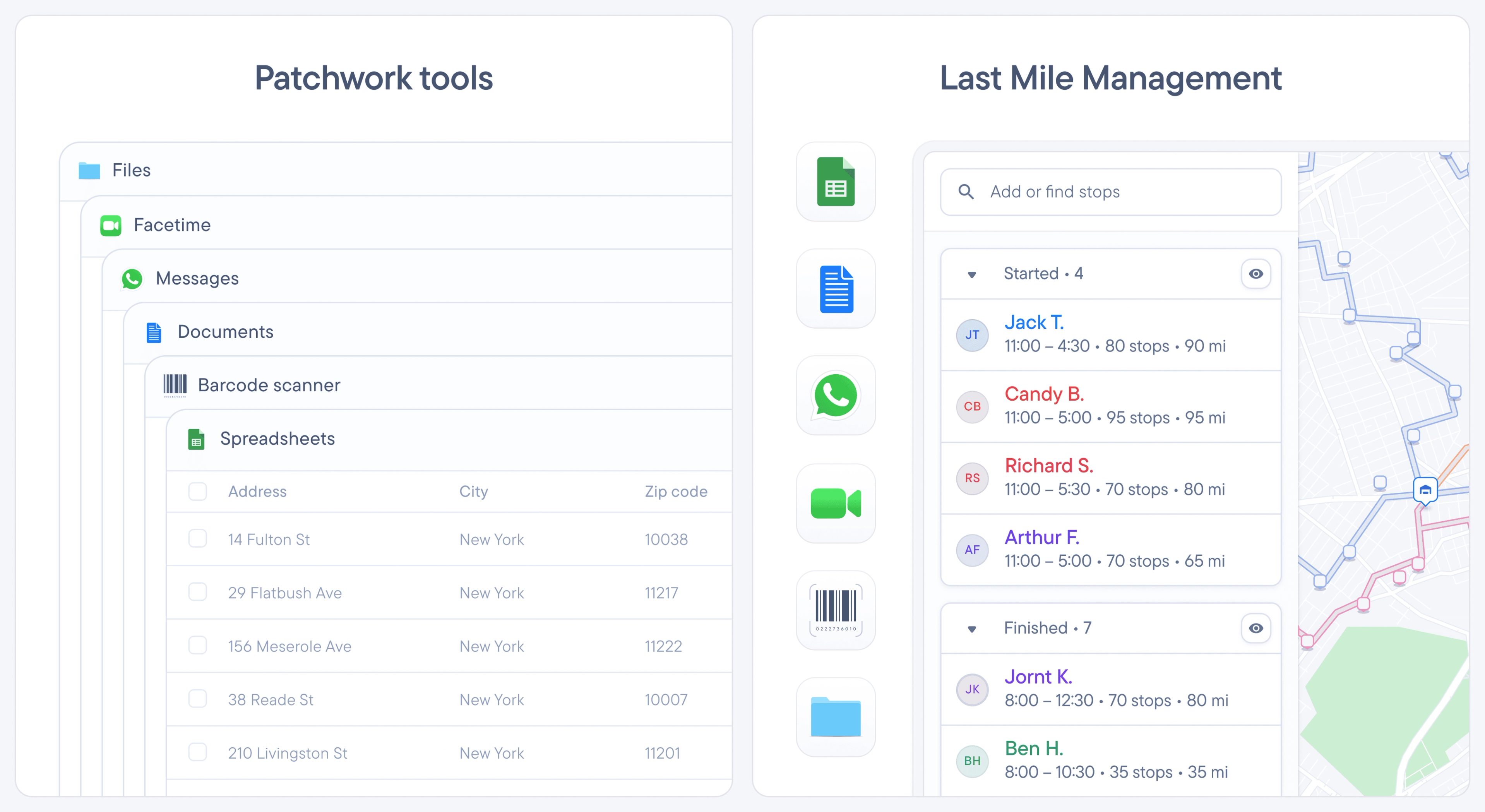
What is last mile management?
Last mile management is the practice of planning, coordinating, tracking, proving, and improving the final stage of delivery. It includes the workflows that connect routes, drivers, clients, recipients, proof of delivery, exceptions, and delivery records so the last mile can run reliably at scale.
For courier companies, it takes on a specific shape. A courier serves multiple shipper clients at once, each with its own rules, terminology, and delivery requirements. The job is not only moving parcels. It is managing the relationship between the client who booked the delivery, the courier driver running it, and the recipient waiting for it, across every route and exception. Generic delivery tools aren’t built for that three-way relationship.
What last mile management includes
Last mile management is a set of connected workflows. There are core pieces across operations of all sizes, but they get harder to hold together as volume grows:
- Route planning and optimization. Sequences stops across drivers, vehicles, and time windows to hit each client’s promises.
- Automated dispatch. Assigns the right stops to the right drivers, and reassigns when the day changes.
- Live route tracking. Shows where every driver is on a GPS map, so you answer a client before they worry.
- Recipient notifications. Tells the person waiting when their delivery’s coming, with branded, automatic updates.
- Proof of delivery. Captures evidence a drop happened, and proof of custody from the moment a package is loaded.
- Exception and failed-attempt handling. Sorts the stops that didn’t go to plan, from a wrong address to a missed knock.
- Multi-depot management. Matches drivers and routes to specific depots and runs a hub-and-spoke network from one screen.
- Reporting. Tracks the numbers behind every route, driver, and stop, so you can see what worked and what didn’t.
On their own, these are eight separate tasks. Last mile management is what links them, so a failed delivery attempt updates the client, files the proof, and shows up in the cost report automatically. One unified operation instead of eight workflows that don’t talk to each other.
Last mile management vs. last mile delivery
Last mile delivery is the act of moving goods to the final recipient. Last mile management is the practice of coordinating everything that makes a delivery succeed: the routes, drivers, proof, exceptions, and reporting. A few related terms get confused with both, so here’s how they compare.
Term | What it means | How it differs from last mile management |
|---|---|---|
Last mile management | Planning, coordinating, tracking, proving, improving delivery | N/A |
Last mile delivery | Moving goods from final depot to recipient’s doorstep | Delivery moves the parcel; management runs the operation. |
Route optimization | Sequencing stops and assigning routes across drivers | One key component of last mile management, not all of it |
Transportation management system (TMS) | Software for freight and transport across the supply chain | Built for shippers and 3PLs; more upstream toward first and mid mile |
The challenges of managing the last mile
The last mile is the hardest stage to manage, and the most expensive. Earlier stages move freight in bulk; the last mile breaks it down to individual stops, each with its own address, time window, and recipient who might not be home. That fragmentation is exactly where things go wrong: Harvard Business Review reports that up to 20% of deliveries fail on the first attempt, and higher where addresses and access are hard to verify.
“When you have a failed delivery attempt, it has to be redone. Who foots that bill? Where does that come from? You have every stakeholder angry, the retailer, the recipient, the driver and the courier. It’s expensive and annoying for everybody”

For a courier company, the difficulty compounds, because every one of those problems multiplies across clients. A few coordination challenges show up again and again:
- Failed attempts and redelivery. Every missed knock is a second trip and a client to update. At volume, it eats the margin on a contract.
- Visibility gaps. When you can’t see how a route is progressing, the only way to answer a client is to call the driver mid-run, and the answer comes late, if at all.
- Proof disputes. A client says a drop never arrived. With no proof from the stop, the courier eats the cost or argues from memory.
- Multi-client sprawl. Every client has its own proof rules, stop names, delivery windows, and reports, and you can’t hold all of it in your head.
- Scaling without errors. What works at 200 stops a day breaks at 2,000 unless the coordination can absorb the volume.
These are not delivery problems in the sense of traffic or weather. They are management problems: keeping the work coordinated, proven, and accounted for as it scales.
Why courier companies need last mile management
Courier companies need last mile management because the last mile is their most expensive, failure-prone stage, and most couriers still run it on a patchwork of tools that were never built to work together.
That problem usually grows one client at a time; A route planner here, a spreadsheet there, a proof of delivery app, WhatsApp for the drivers, a separate export for each client’s report. None of it was chosen as a system; it accumulated because each new contract needed something the last tool couldn’t do. Megan Murphy, General Manager of Spoke Dispatch, sees the same setup across the industry:
“It’s becoming more complex for couriers to satisfy the needs of all their stakeholders. Couriers are managing deliveries for their sellers and their buyers, all while trying to keep their drivers happy... Otherwise, their day-to-day is completely bogged down trying to fulfill all these expectations.”
The cost lands on the dispatcher and, eventually, on the contract. Every client added multiplies the manual stitching: another proof rule to remember, another order format to rekey, another report to assemble by hand. And it isn’t only clients that vary. Even driver pay models can vary from one courier to another, as Murphy explains:
“Some couriers will pay their drivers by the hour, some by the delivery attempt, some by successful deliveries only, some by the kilometer or the mile... if you don’t support that cost structure or that employment relationship, it can completely break the business itself.”
Without last mile management, nothing connects, so a failed attempt doesn’t update the client, the proof sits in a separate app, and the added cost never makes it into a report anyone can act on. At low volume, it’s a problem, but businesses can still hold it together. But at scale, it starts to break.
Last mile management is the fix because it replaces the patchwork with one system built for the last mile specifically, not a route planner with features bolted on, and not a freight TMS reaching downstream. Routes, proof, client answers, driver pay, and everything else run in the same place, so couriers have a central, connected system they can rely on as the operation grows.
When couriers make the switch to last mile management
Most operators know their setup is held together with tape. The barrier is time and the fear of onboarding a new system mid-contract, which is why the move tends to happen at a breaking point.
KW Delivery hit that wall when the work scaled up. When founder Paul LeBlanc signed a high-volume FedEx contract, he found the disconnected tools his team relied on couldn’t handle the routes the volume demanded.
“On the day we agreed the FedEx contract, I was looking for apps to help my team manage the high-volume routes. Frankly, it would’ve been disastrous if I hadn’t found Spoke.”
Within 48 hours of signing up with Spoke, KW was running the FedEx contract. They went from 50 orders a day and no last mile work to 550, on one system instead of the apps that couldn’t have carried it.
Read the full KW Delivery story.
Why last mile management matters
Strong last mile management changes the dispatcher’s day. You answer a client in seconds instead of calling a driver to find out, catch a bad address before dispatch, and reassign stops in a few taps when the day changes. Each of those is time and client trust the current setup quietly costs you.
When you have a connected view of every part of your operation, the decisions get clearer. If your failed-delivery rate drops a few points, you keep clients who were one bad week from leaving. If you can see exactly what each route costs to run, you can price the next contract properly. That’s the shift from reacting to planning: catching problems before they cost you and tuning the operation as it scales.
Spoke Dispatch is built to give couriers the visibility and control they need - routes, proof, client answers, and costs in one place instead of six. Start a free trial and bring control and efficiency to your last mile operation.
How to measure last mile management
Measuring last mile management comes down to a handful of metrics that track whether deliveries are landing, what they cost, and whether you’re hitting each client’s terms. These five matter most, because each maps to a decision a dispatcher or owner makes that week.
- First-attempt and on-time rate. Measures the share of stops delivered on the first try, in the promised window.
- Failed-delivery and reattempt rate. Tracks how often a stop comes back, and how many tries it takes to clear.
- Cost per delivery. Shows what a completed delivery costs to run, by route or by client.
- Time-at-stop. Records how long drivers spend at each stop.
- SLA adherence. Measures how often you meet the delivery terms each client agreed to.
Together they give you a clear read on the operation, so you can tune your workflows and take on the next big client.
The future of last mile management for courier companies
Most delivery software does not put courier companies first. It serves them as one vertical among many, somewhere between florists, cannabis dispensaries, furniture, and meal-prep. Spoke Dispatch is built specifically for courier workflows instead.
Done well, last mile management gives a courier the room to manage the promises around a delivery. A recipient’s plans change and they need a different delivery window, and the courier handles it without scrambling the day. Delivery preferences, client visibility, proof, and failed-attempt recovery stop being costs to absorb and become strengths a courier can stand behind.
High-volume courier work is unmanageable on tools built for something else, and the gap shows up exactly when the contract gets big enough to matter. If you run a courier operation, see how Spoke Dispatch handles last mile management for couriers.
Frequently asked questions
No. A transportation management system is built for shippers and third-party logistics providers coordinating freight across the whole supply chain. Last mile management is narrower and deeper: it owns the final stage of delivery, where the recipient is a person and proof matters, and it is built around the dispatcher’s day rather than enterprise freight.
The ones that tie to a decision: first-attempt and on-time delivery rate, failed-delivery and reattempt rate, cost per delivery, time-at-stop, and SLA adherence. Together they tell a courier operator whether their last mile operation is improving or just busy, and which clients or routes need attention.
It depends on the size of the company. At a smaller courier, the dispatcher is often the founder or owner, doing both jobs at once. At a larger one, it is usually a dedicated dispatcher or operations lead. Either way, that person coordinates routes, drivers, clients, recipients, and exceptions, and they are held accountable when a delivery cannot be proven or a client cannot get an answer.
A retailer with an in-house fleet manages one set of delivery rules, its own. A courier company delivers for many shipper clients at once, each with different proof requirements, terminology, delivery windows, and reporting needs. The courier is effectively running several delivery operations in parallel, which is the part generic delivery software does not model.
They use a last mile management software that combines route planning, live tracking, recipient notifications, proof of delivery, and client visibility in one place, rather than stitching together separate tools. Fit matters more than feature count: a courier needs a platform it can configure per client. Spoke Dispatch is built specifically for that multi-client courier model.