
Without proof of delivery, every disputed delivery is your driver's word against the client's. Without evidence, you lose that argument every time.
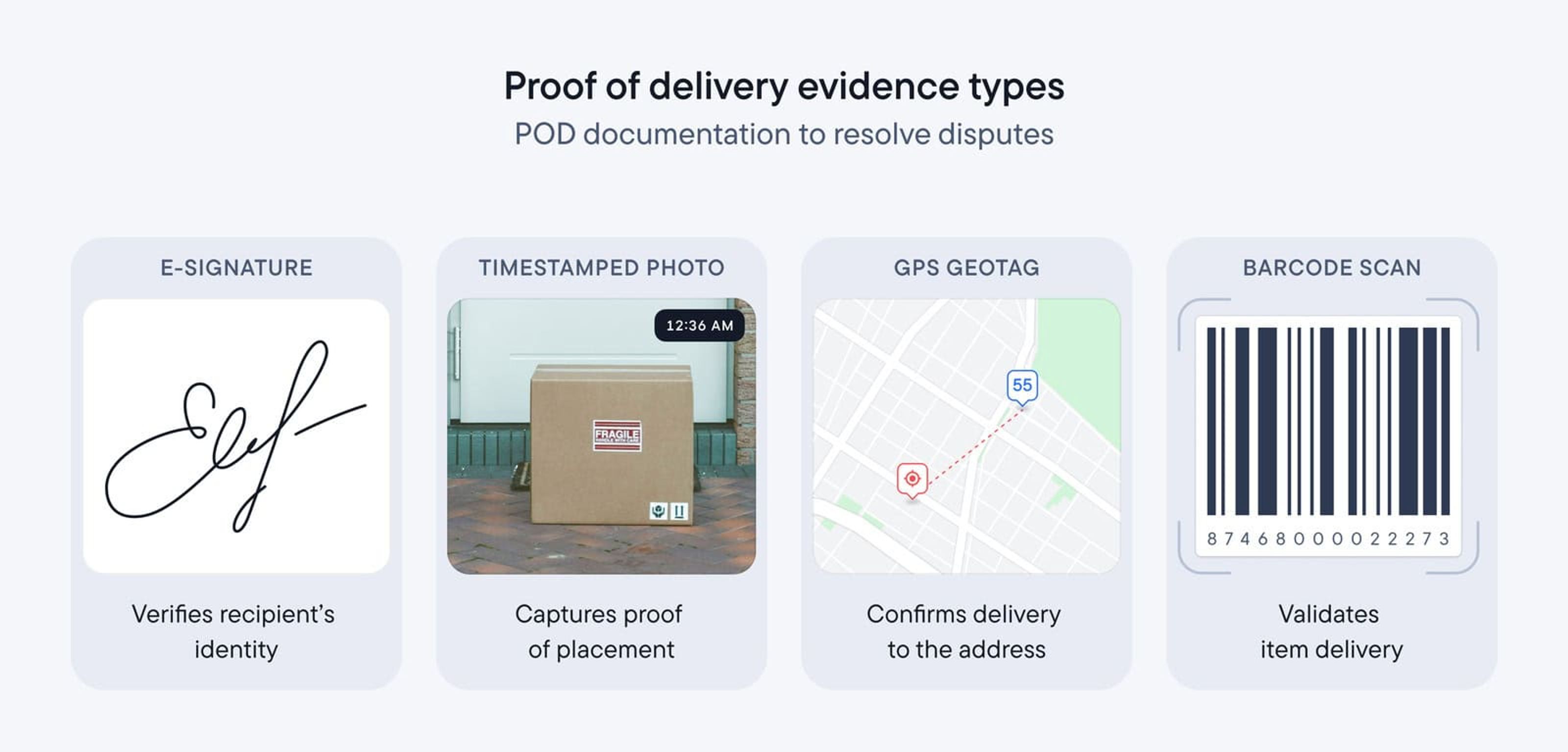
That evidence is what proof of delivery apps capture: electronic signatures, timestamped photos, GPS coordinates, delivery notes. Documentation that resolves disputes before they become chargebacks, protects contracts before they become cancellations, and gives your clients the confidence that drives repeat business.
This guide compares five proof of delivery software options built for courier operations - not route planners with POD bolted on, and not enterprise platforms priced for companies running tens of thousands of daily tasks. These are tools that courier companies actually use, evaluated through the lens of what matters to dispatchers and operations managers: POD depth, operational fit, honest pricing, and the kind of evidence that holds up when a delivery is contested.
Proof of delivery app comparison
Platform | User rating | Key POD features | Pricing | Best for |
|---|---|---|---|---|
Spoke Dispatch | 4.8/5 (100+ reviews) | Signature, photo, barcode scanning, geotags, timestamps, notes; Flexible POD per stop. Offline capture; No expiration on stored POD files | From $125/month (unlimited drivers) | Total last mile management control for courier companies |
Track-POD | 4.5/5 (35+ reviews) | Signature, up to 10 photos, customizable ePOD templates, PIN code verification, offline mode | From $49/driver/month | Deep POD customization and offline capture |
Onfleet | 4.8/5 (4,500+ reviews) | Signature, photos, notes, barcode scanning, age/ID verification | From $619/month | High-volume operations with regulatory requirements |
DeTrack | 4.7/5 (80+ reviews) | Contactless SMS POD, geofencing, mass POD submission, photo, signature | From $29/driver/month | Small courier teams going from paper to digital |
OnTime 360 | 4.3/5 (35+ reviews) | Signature, photo, barcode, GPS coordinates, timestamps | From $49/month (flat rate, unlimited users) | Established courier companies wanting all-in-one operations |
1. Spoke Dispatch - Best for courier companies that need full last mile management
"As soon as our drivers capture a photo or signature, it's immediately visible on the dispatcher's dashboard. This fast visibility ensures that we can react quickly to any delivery issues and maintain accurate, up-to-date records. It's a straightforward yet powerful tool that keeps our team and clients on the same page."

Spoke Dispatch isn't just a proof of delivery app - it's last mile management software where POD is one key capability within a full courier operations platform. Dispatch, route optimization, real-time tracking, customer notifications, analytics, and proof of delivery all work together under one system designed exclusively for courier companies.
POD that works as operational evidence
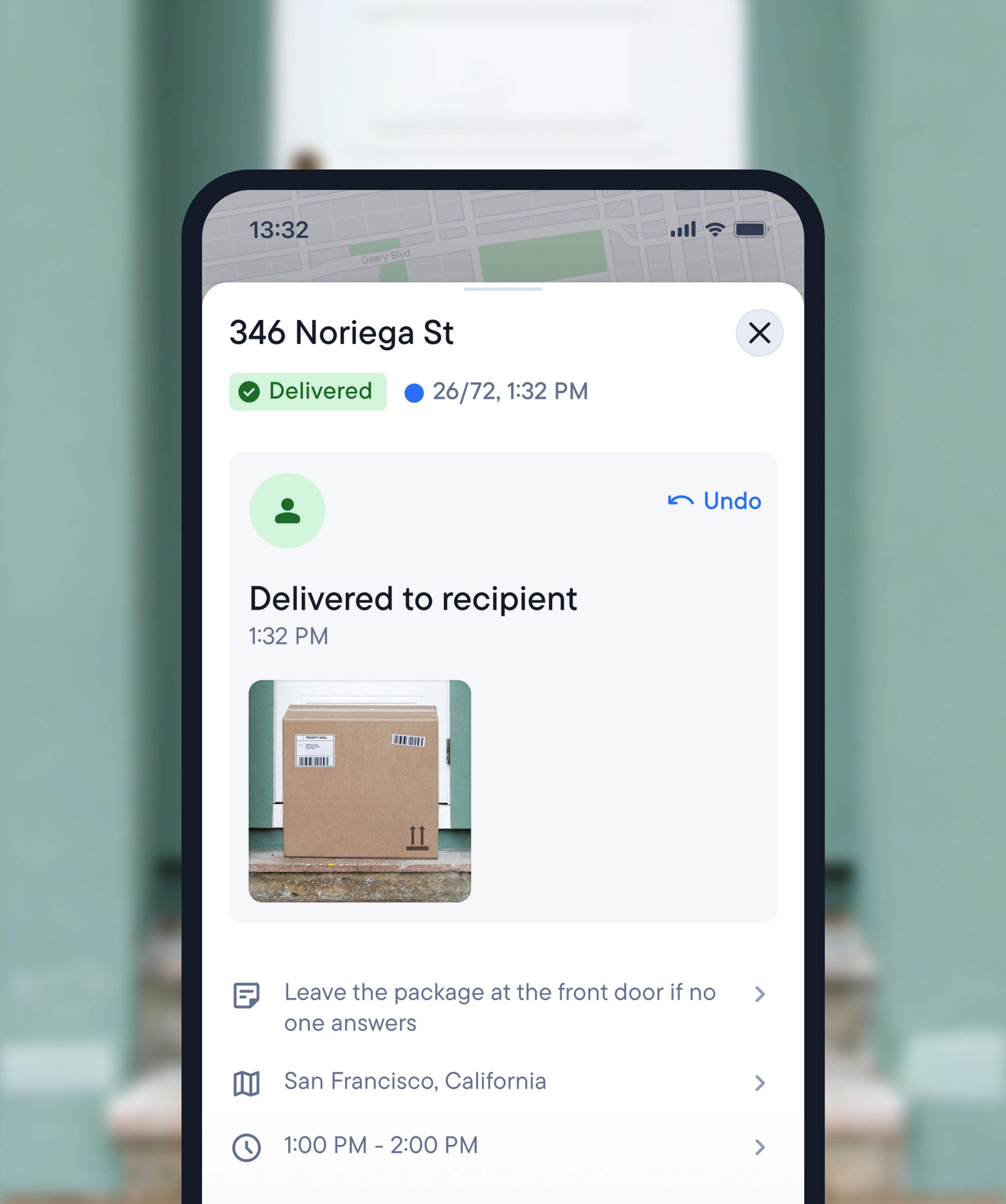
Spoke Dispatch captures the full range of POD types - signatures, photos, barcode scans, timestamps, notes, and GPS geotags - and syncs everything instantly to the dispatcher dashboard. That immediate visibility protects you on two fronts: catching a delivery issue in real time rather than the next morning, and shielding you from client queries before they happen.
What sets Spoke Dispatch apart from the other tools on this list:
- Dispatchers choose which stops require proof of delivery and which don't - your drivers aren't spending 30 extra seconds at every residential doorstep when only your commercial clients require signed confirmation.
- POD files are stored with no expiration - there's no 90-day window or archival fee. How far back you can access historical data depends on your plan tier, but the files themselves aren't deleted.
- Drivers can capture signatures and photos without an internet connection, with everything syncing automatically when they're back online - important for rural routes and low-connectivity areas.
- Recipients get automated updates, including delivery confirmation with the POD evidence your driver captured, which means fewer "where's my package?" calls to your dispatch desk.
- Retail clients get direct visibility into POD status through Spoke Connect, where they can check any order on the platform themselves.
Spoke Dispatch is built on a Google Maps partnership - and we're the only delivery app where Google's commercial team actively pushes adoption - which means route optimization quality and address validation come built in.
What courier companies are saying
RoadRunner, a fleet management and driver recruitment company in Australia, put it simply:
"Lots of clients are still very old school in terms of their tech systems. No ETAs, no ability to track the drivers. POD that they can't access for hours or even until the next day! It's just old and clunky, so by using Spoke Dispatch, we definitely have the advantage."

Ethic Transport, a Belgian courier that grew from one to five drivers quickly, built their reputation on a 100% parcel delivery rate - documented and provable through the Spoke Dispatch POD system. Their clients "knew that if we took 100 parcels, we'd deliver all 100 parcels."
And KW Delivery in Canada scaled from 50 to 500 deliveries per day after adopting Spoke Dispatch. Owner Paul LeBlanc:
On the day we agreed to the FedEx contract, I was looking for apps to help my team manage the high-volume routes. Frankly, it would've been disastrous if I hadn't found Spoke Dispatch.
Combined with the Connect client portal for direct retailer visibility, Spoke covers the full last-mile management workflow from dispatch to doorstep.
2. Track-POD - Best for courier fleets that need deep POD customization and offline capture
Track-POD has the deepest proof of delivery feature set on this list - which makes sense, given that POD is literally in the name. If your courier operation needs highly customizable electronic proof of delivery with granular control over what gets captured at each stop, Track-POD delivers on that specific need.
What Track-POD does well
Track-POD's standout is the ePOD template system. You build your own POD forms with conditional fields, checklists, and custom data capture. Medical, pharmaceutical, and high-value goods clients usually have specific documentation requirements. Track-POD lets you configure exactly what your drivers need to capture at each stop. The templates mean a pharmaceutical client's POD requirements don't bleed into your retail routes.
Drivers can capture up to 10 photos per delivery - more visual documentation capacity than any other tool on this list. The platform also auto-generates fully customizable POD PDFs branded to your operation, and PIN code verification lets recipients confirm delivery with a code for high-security or high-value drops. This is available on Advanced Plus and Enterprise tiers. Offline mode means drivers can capture POD without internet access, with automatic sync when connectivity returns.
Reviews of Track-POD point to three recurring themes: the depth of features, the quick pace of app development, and the live fleet visibility. One G2 reviewer noted it's "a great local delivery tracking app, fully featured," specifically calling out that the team is "constantly improving the app and regularly keeping us up to date on newly added features, redesigns, and improvements." Another described the fleet visibility as a standout: "It also gives my business great visibility of the whole fleet."
What to watch out for
Track-POD charges per driver. That starts affordable - $49/driver/month at the Standard tier - but costs scale linearly with your fleet. A 20-driver operation is paying $700/month before you get to the features gated behind higher tiers. Geofencing and PIN code verification require the Advanced Plus plan, and essential capabilities like route optimization aren't available at the base tier.
The mobile app and initial setup have drawn criticism in reviews. Multiple users describe the mobile interface as clunky, and the onboarding process takes longer than expected for teams used to simpler tools.
Track-POD isn't courier-specific - it serves any delivery operation. That's not a dealbreaker, but it means the platform isn't built around courier workflows like multi-depot management, dispatcher-to-driver assignment, or contractor driver oversight. If your operation's complexity extends beyond the delivery itself, you may find gaps. But for courier companies evaluating proof of delivery software specifically for POD depth rather than full operational coverage, Track-POD is worth a serious look.
Track-POD is the right fit for courier companies that need deep, customizable POD documentation - especially those with clients requiring specific capture formats - and are willing to pay per-driver pricing for that level of control. If Track-POD isn't the right fit, you'll find a detailed breakdown of Track-POD alternatives here.
3. Onfleet - Best for high-volume courier operations with regulatory requirements
Onfleet is built for high-volume delivery operations that need compliance-grade POD features. With 4,500+ ratings at 4.8/5, it has the strongest social proof of any tool on this list. If your courier operation handles regulated goods and needs barcode scanning or age/ID verification as part of the POD workflow, Onfleet is worth evaluating.
What Onfleet does well
Onfleet's regulatory POD features are the standout. Barcode scanning creates scan-to-confirm delivery workflows with an auditable chain of custody - essential for pharmaceutical, medical, and regulated goods delivery. Age and ID verification give you built-in workflows for age-restricted deliveries like alcohol, cannabis, and controlled substances. No other tool on this list offers native ID verification.
The API is enterprise-grade, which matters for courier companies that need to connect POD data to existing operational systems. Automated SMS notifications and customer feedback forms keep recipients informed and give you structured delivery feedback.
Users praise the real-time responsiveness. One G2 reviewer noted: "When you make changes, they're reflected across all dispatchers and all drivers instantly."
What to watch out for
Onfleet is expensive. The Launch tier starts at $619/month. Barcode scanning and age verification - the regulatory features that justify the "regulatory requirements" label - are only available from the Scale tier at $1,349/month. For a growing courier company with 10-50 drivers, that's a significant commitment before you've proven ROI. Multiple users note the cost: "It really is horrifically expensive," wrote one G2 reviewer, while another observed that "the account manager only hits you up to raise prices on you." Features that feel standard elsewhere are priced as add-ons.
On the operational side, Onfleet limits the number of pickups and stops per driver, which becomes a friction point at scale. And reviews flag route optimization that doesn't account for live traffic.
Onfleet serves in-house delivery teams alongside courier companies. That broader market means the platform is well-resourced and well-supported, but it also means it isn't exclusively optimized for courier-specific workflows like multi-depot management or hybrid fleets that mix employed and subcontracted drivers.
Onfleet is the right fit for large courier operations (50+ drivers) handling regulated deliveries where barcode scanning and ID verification are non-negotiable - and where the budget supports premium pricing.
4. DeTrack - Best for small courier teams transitioning from paper to digital POD
DeTrack is the budget entry point on this list, and it earns its spot with some genuinely differentiated POD features. It's not courier-specific - DeTrack serves 35+ industries from retail to food delivery - but for small courier teams making the jump from paper waybills to digital proof of delivery, it offers a low-risk starting point.
What DeTrack does well
DeTrack's standout is contactless SMS-based POD. The customer receives a text link and signs digitally from their own device - no physical contact, no shared screens. No other tool on this list does this.
Geofencing verification adds another layer: GPS-based delivery confirmation that checks whether the driver was within a defined radius of the delivery address. Proof of location, not just proof of action. For bulk operations, mass POD submission lets you submit proof of delivery for multiple stops at once - useful for high-volume drops where individual signatures aren't practical. The driver app also includes built-in pre-route vehicle safety inspection checklists.
What to watch out for
The Pro plan starts at $29/driver/month, but that headline price doesn't include routing. For route optimization, you need the Advanced plan ($39/driver/month) or the separate ElasticRoute add-on - so the real cost for a courier company is higher than $29.
DeTrack is delivery management software, not courier operations software. Your drivers get a solid app for capturing POD, but the platform isn't as deep around courier-specific workflows like multi-depot management or commercial contract management. For a five-driver team replacing paper waybills, that's fine - you're solving the POD problem, and DeTrack solves it well. For a growing courier company that needs courier-specific dispatch, multi-client management, and operational oversight alongside POD, you'll hit the ceiling relatively quickly.
The 35+ industry focus also means you won't find courier-specific terminology or workflows in the platform. It's built for "deliveries," broadly, not for the specific operational patterns of a courier company managing commercial contracts with SLAs and multiple client accounts.
DeTrack is the right fit for small courier teams (under 10 drivers) that need proof of delivery software without a large upfront commitment - especially those who value contactless delivery confirmation and geofencing.
5. OnTime 360 - Best all-in-one operations platform for established courier companies
OnTime 360 is the only other tool on this list besides Spoke Dispatch that was built exclusively for courier companies. Developed by Vesigo Studios in Medford, Oregon, OnTime has served the courier and messenger industry for 26 years - competing in the same courier-specific software category as CXT and Xcelerator, not the generic delivery tool market.
OnTime 360 has a complete courier business management platform with dispatch, billing, invoicing, customer portal, and POD under one roof. Its proof of delivery features cover the basics - signatures, photos, barcode scanning, GPS coordinates, and timestamps - but lack the customizable templates of Track-POD or the contactless SMS capture of DeTrack. The POD isn't the reason to choose OnTime. The operational breadth is.
What OnTime 360 does well
OnTime covers dispatch, driver management, real-time tracking, POD, billing and invoicing, a customer self-service portal, and accounting integration with QuickBooks, FreshBooks, and Xero. It also handles time clock, driver wage calculation, and flexible pricing sets that support the complex per-client rate structures courier companies actually use. For a courier company running 50 clients with different rate cards, that pricing flexibility alone can save hours of manual invoicing each week. The Enterprise plan ($499/month) includes HIPAA/GDPR compliance - relevant for courier companies handling medical or regulated deliveries.
Every plan includes unlimited users. To put that in context: a 15-driver operation on Track-POD would pay $735/month for drivers alone. OnTime's Team plan is $99/month regardless of team size. The driver app works offline with auto-sync, and the platform's terminology, workflows, and feature design reflect 26 years of building exclusively for the courier and messenger industry.
What to watch out for
The $49/month starting price is misleading. The Core plan includes only 100 shipments per month at $0.35 per additional shipment - a courier company doing 500 shipments monthly would pay roughly $189, not $49. The customer portal requires the Team plan ($99/month), and invoicing and accounting integration require the Business plan ($249/month). Realistic entry for a working courier company is $99-249/month.
The UX is dated. Reviews consistently describe the interface as having a "Windows-era aesthetic," and the desktop applications (dispatcher and management suite) are Windows-only - Mac users need virtualization. The mobile driver app is the most criticized component, described as "archaic" in multiple reviews. And OnTime doesn't offer customer ETAs or automated delivery notifications, which is a notable gap for modern delivery expectations.
OnTime 360 is the right fit for established courier companies with 10+ drivers that need dispatch, billing, invoicing, and POD in a single platform - and prioritize operational completeness over modern UX.
Which proof of delivery app is right for your courier operation?
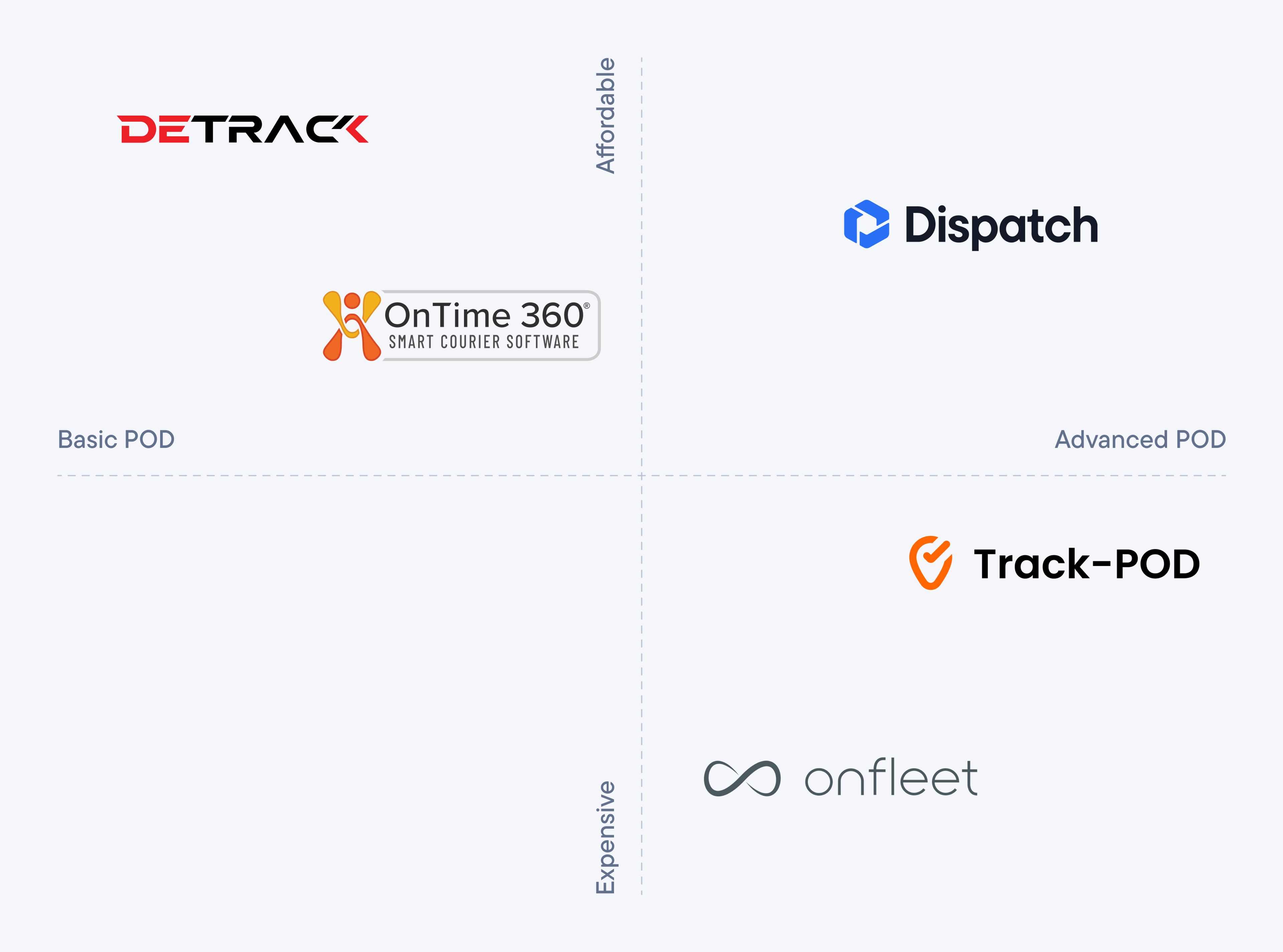
Which proof of delivery app fits your courier operation best?
The right proof of delivery software depends on what your operation actually needs - not which tool has the longest feature list. These six scenarios cover the most common decision points.
You're running 50+ drivers across thousands of daily stops. You need a platform that scales without per-driver costs becoming the dominant line item. Spoke Dispatch (from $125/month with unlimited drivers) and OnTime 360 (flat rate, unlimited users) both avoid per-driver pricing. Onfleet handles this volume, but at $550+/month minimum.
Your drivers operate rural or low-connectivity routes. Offline POD capture isn't optional - it's operational. Track-POD, OnTime 360, and Spoke Dispatch all support offline capture with automatic sync. DeTrack and Onfleet require active connectivity.
You manage contractor fleets and need POD as accountability. When your drivers aren't employees, documented proof of delivery is your only protection when a contractor claims they delivered and your client says they didn't. That dispute gets resolved by evidence, not phone calls. Look for flexible POD per stop (Spoke), customizable ePOD templates (Track-POD), or geofencing verification (DeTrack) - different tools for different accountability models.
You're replacing paper waybills for the first time. Start with what you can afford. DeTrack's $29/driver/month entry point and contactless SMS POD make the transition low-risk. OnTime 360's flat-rate pricing keeps costs predictable as you add drivers. Once you know which POD features your clients actually need, you can evaluate whether to scale up.
You handle medical, pharmaceutical, or age-restricted deliveries. Three tools on this list serve regulated use cases, each differently. Onfleet offers barcode scanning and age/ID verification, though both require the $1,265/month Scale tier. OnTime 360's Enterprise plan includes HIPAA/GDPR compliance. Spoke stores POD files with no expiration and supports offline capture for low-connectivity environments like hospital loading docks and rural clinics.
You need full courier operations management, not just POD. If the real problem is managing dispatch, route optimization, tracking, billing, AND proof of delivery - not just POD in isolation - Spoke Dispatch and OnTime 360 are the two courier-built platforms that cover the full workflow.
See how Spoke Dispatch handles proof of delivery alongside route optimization, real-time tracking, and delivery analytics - try it free for 7 days at dispatch.spoke.com/signup.
Proof of delivery FAQ
Proof of delivery is evidence, not a contract. Its legal weight depends on the jurisdiction and the quality of documentation. Digital proof of delivery software captures timestamped, geotagged, electronically signed records that carry significantly more weight than a paper waybill in dispute proceedings. Medical couriers in many US states face POD retention requirements of 5+ years, so choosing a platform with strong data retention policies matters.
POD provides verifiable evidence of who signed, when, where, and in what condition. Instead of he-said-she-said between your team and the client, you produce a timestamped photo, a GPS coordinate, and an electronic signature. Courier companies with documented POD resolve disputes faster, retain clients at higher rates, and reduce chargeback exposure - because the evidence exists before the dispute does.
Yes - but not all of them. Track-POD, OnTime 360, and Spoke Dispatch offer offline POD capture with automatic sync when connectivity returns. This matters for rural routes, warehouse environments with spotty Wi-Fi, and any delivery area where consistent mobile coverage isn't guaranteed. If your drivers regularly operate in low-connectivity zones, offline POD should be a selection criterion.
Different documents, different purposes. A bill of lading is a contract and receipt at the shipping origin - it documents what was handed to the carrier and the terms of carriage. Proof of delivery confirms the delivery happened at the recipient end - it documents what arrived, when, where, and who accepted it. Courier companies primarily deal with POD. Bills of lading are more common in freight and shipping contexts.
It depends on your clients and your jurisdiction. Medical courier contracts in many US states require 5+ years of documented delivery records. General commercial contracts typically benefit from a minimum 2-year retention window for dispute resolution. When evaluating platforms, check their data retention policies - some delete POD files after a set period, others store them with no expiration. Your plan tier may also affect how far back you can access historical records.
POD is almost always a feature within broader dispatch or delivery management platforms - standalone proof of delivery software doesn't really exist as a category. The real question is whether you need just POD (DeTrack or Track-POD might be enough) or whether you need full operational management with dispatch, routing, tracking, billing, and POD working together (which points to Spoke Dispatch or OnTime 360). The five tools in this article cover both ends of that spectrum.
Ready to see how proof of delivery fits into full last-mile management? Start your free trial at dispatch.spoke.com/signup.