If you’re a dispatcher, we’re willing to bet you beat the drivers in every morning, leave after the last van’s back, and spend most of the hours in between with a phone glued to your ear.
It’s nothing short of a juggling act and you’re the one keeping every ball in the air.
Put simply, dispatch management is the work of deciding which driver takes which stops, in what order, and then keeping that plan alive throughout the day as things change.
For a courier company, that might mean:
- Taking hundreds or thousands of stops a day from more than one client
- Mapping those stops into routes for a fixed set of drivers
- Sitting in the middle of it all as the hub between the client, the driver, and the end customer
This isn’t to be confused with the kind of dispatch management that sends plumbers, techs, or trades out to fix a job. We’re talking another scale entirely that often involves hundreds of stops, several clients to please at once, and multiple drivers.
Here’s a potted overview of what dispatch management involves for a courier company and ways to ease some of the repetitive, frustrating parts of the job.
What is dispatching in business?
In a general, non-courier sense, dispatching is sending a person or vehicle to do a job. Everyday examples might be a tow truck sent to a breakdown or a technician sent to fix a broken AC unit.
Courier dispatching is slightly more complex and often works on an entirely different scale. The “job” is a full route of, say, 60 or 120 stops per driver, per day, mapped out in an order that makes the most sense. And that multi-stop route needs to weather the storms of gnarly traffic, sick drivers, and all sorts of other unexpected hold-ups.
Most of the time, managing this circus falls to one person: you, the dispatcher.
You’ve probably had days where everything clicks into place and you feel great, and others where… well, it all falls apart and you’re left scrambling to pick up the pieces.
What a courier dispatcher does all day
Every courier op has its quirks (as you well know), but the “shape” of the day is pretty similar from one depot to the next.
This “shape” is defined by five core questions you have to answer over and over again:
- Who takes what?
- What order are things delivered?
- What happens when a driver drops out?
- What happens when a stop fails?
- What does a client get told?
6am: The pre-dawn paperwork
You’re up and at ‘em before your drivers are, sorting out which clients need what and when.
There’s a good chance you’re juggling a couple of dense CSV files and a PDF or two (there’s always one). Before you do anything, you need to turn this garbled info into one clean list.
7am: Mapping the routes
Here come the first two decisions: who takes what, and in what order?
If you’ve got 600 stops and 12 drivers, who gets the pharmacy run that needs signatures and has to be done by 11? Who gets the residential block where parking is a nightmare? Which stops have hard-stop time windows?
This route planning part of the job relies on a lot of hard-won experience. A good dispatcher is thinking about distance, sure, but also about who knows which neighborhood and which vans fit the bulkier stuff.
8am: Loaded and gone
Drivers have their routes (on paper, in a group chat, in an app, or some mix of all three) and they head out. For about an hour things go gloriously quiet. Grab a coffee and enjoy it.
10am: The first curveball
This is when decision three comes into play: what happens when a driver drops out or something happens so they can’t finish their route?
In a split second, your well thought-out 7am plan no longer works, so you have to go back to the drawing board and figure out whose route has buffer room and what you can push to tomorrow. Then, you need to phone up every driver affected and let them know the change of plan.
Midday: The curveballs keep coming
Wrong addresses, nobody home, the gate code doesn’t work. At this point, you might start to see stops failing left, right, and center. It’s your job to decide whether the driver tries again later, brings the package back to the depot, or calls the customer. Multiply that by a couple dozen and it quickly eats into your day.
2pm: Where’s order #234?!
The fallout continues with clients calling to query the status of their orders. You’ll probably spend a ton of time scrolling through your spreadsheet and checking the group chat. You’ll call the driver, which is all well and good until you have to make eight five-minute calls in just a few hours.
5pm: Closing out the day
Drivers roll back in and the reconciling starts:
- What was delivered?
- What didn’t get delivered and why?
- What goes back out tomorrow?
And… by the time that’s done, you’ve got tomorrow’s CSV files and PDFs pouring in ready for that 6am start.
A quick note on measurement here…
It can be tricky to know how your dispatch op is going if you’re not tracking it. Just because nobody’s quit yet doesn’t mean it’s all sunshine and roses.
Here’s what to look for:
- Delivery success rate. How many stops got delivered on the first try?
- Failed-stop reasons. Why did stops fail and is there a common reason?
- On time rate within time windows. How often are your deliveries on time?
- Planned vs. actual route times. Do routes keep running over?
How do you know when manual dispatch has hit its limit?
None of the above issues are a major problem when you’re small.
Plenty of great courier companies have run for years on a spreadsheet and someone’s excellent memory. The catch is that a manual setup like that doesn’t explicitly tell you when it’s hit (or about to hit) its limit. It just… gets a little harder every week.
These are the signs we see most often:
- You’re on the phone putting out fires more often than not. When most of your day’s spent on calls, you’re sacrificing time you could be spending doing other, more useful tasks.
- Drivers are making their own routes. If drivers reshuffle what you sent because it makes more sense, your plan probably isn’t working as well as you think it is. (We've written more about how to manage delivery drivers).
- Nobody has one true picture of the day. The manifest might be in a spreadsheet, the changes in the group chat, and the rest buried somewhere in your head. You’re the glue that holds it all together, so if you’re off sick there are gonna be problems.
- You’ve added a new client to your roster. Each new client brings their own file format and their own way of flagging priority stops. Before long, you’re working to multiple different systems that don’t sync.
- More drivers means another dispatcher. Taking on more work often means hiring someone to do what you already do, which ultimately means thinner margins.
It’s tempting to look for a magic number where things tip over, like 10 drivers or 500 stops.
In our experience it’s rarely a number that does it. It’s usually something that seems pretty arbitrary at the time, like a second or third client, or you going on your first vacation.
Here's an example of how that plays out.
Say you run a courier op with 12 drivers delivering for three clients:
- A regional pharmacy group
- An ecommerce brand
- A bigger carrier passing over its overflow
Together, they send you around 600 stops a day. That’s around 50 per driver, which all sounds very doable on paper…
…until the pharmacy sends a spreadsheet at 5:45am choc-full of time windows and signature requirements, the ecommerce brand sends a CSV at 6:30 and a second batch at 10, and the carrier's manifest arrives in a different format every day with wildly varying volumes.
Sure, you could hold it together if you got in at 5.30 each morning, spent 90 mins merging files before even thinking about mapping, and then juggling calls from three separate clients all afternoon, but that probably doesn’t sound like your idea of a good time.
Now imagine you want to take a week off or the ecom brand runs a flash sale. You can see how quickly things would fall apart.
If you nodded along to more than a couple of the signs above, it might be worth seeing what your day would look like if you could see every client’s needs and all your stops in one place. You can start your free 7-day trial of Spoke Dispatch and map tomorrow’s routes in it.
What happens when you hand off the repetitive stuff?
If the day we outlined above sounds familiar, you’re not alone. There are a lot of repetitive parts (like mapping routes and fielding “where is my order”, a.k.a. WISMO, calls) that swallow time you’d rather spend on the curveballs, the drivers, and the clients.
There are two ways to outsource these repetitive parts:
- Hire a dispatch management service
- Use a dispatch management system
Dispatch management services vs. a dispatch management system
"Dispatch management services" usually just means paying another company to handle your dispatch for you.
For a one-van op where the owner is also the driver and has no spare hours, that can make sense.
It doesn’t make sense when a client wants to talk to someone who really, truly knows their deliveries… and in courier work that can happen a lot. Obviously, a management service that’s once removed from your ops isn’t going to know the ins and outs of things.
On the flipside, a system keeps dispatch in-house with your own people, and means you can have just one dispatcher running the whole op when it might otherwise take two (or, in some cases, more).
That’s been the experience at CarryAll:
“Our operations team consists of just 9 people, but we achieve double the output of larger businesses I have worked at because we automate as much as possible. Using Spoke, we have saved time on route planning, which means we can put more focus on operations and customer service.”

What a dispatch management system can (and can't) take off your plate
A dispatch management system (sometimes just called a dispatch system) takes on those always-there, repetitive parts of the day so you can focus on the bits that need a real, live human.
Look for these dispatch system features:
- One place for every stop for every client. All manifests go into the same list regardless of their original format (that's what people mean by centralized dispatching).
- Routes mapped and balanced for you. The system orders the stops and splits them across drivers, keeping to time windows, priority stops, and delivery zones. You can check it and tweak it, but all the hard work is done for you.
- A live view of every driver. You can see where everyone is without needing to pick up the phone. (Our guide to last mile delivery tracking goes deeper on this.)
- Changes sent straight to the driver’s phone. If you move a stop or swap a drop, it will automatically show up in the driver’s app.
- Proof captured at the door. Photos, signatures and timestamps are recorded against each stop. If, for some reason, a package doesn’t get delivered, this will be recorded too (along with the reason why).
- Recipients kept in the loop. Automatic texts and emails with a live ETA mean less WISMO calls.
- A record at the end of the day of what was delivered, what failed and why.
If you’re starting to weigh up options, we’ve put together a page on dispatch software for courier companies that covers what to look for.
What you’re still responsible for
So, yes, a dispatch system makes your life a million times easier, but there are a few things that can’t be replaced or automated:
- Any judgment calls. The system can absolutely tell you which route can handle 15 more stops, but you’re the one who knows that a driver is having a rough week and might not be able to handle the extra work.
- Having a quick chat with drivers. If someone’s had a lot of late starts and missed deliveries, it’s still your responsibility to get to the bottom of it.
- Managing clients. You’ll still need to chat with clients who want to talk over their deliveries in detail with an actual human.
- Fixing bad addresses. If a client sends “123 Main St” for a 200-unit apartment building with no unit number, there’s no system in the world that can guess the door number. A good one will at least flag it, but you’ll have to do the digging.
How Spoke Dispatch handles your day
FYI: Spoke Dispatch is a delivery management software made specifically for courier companies and we built it around the day we walked through above.
Here’s how it makes all those fiddly daily tasks much easier.
Firstly, every client’s stops come into one dashboard first thing in the morning, whether you upload a spreadsheet or clients send them in directly. Clients can use Spoke Connect, our client portal, to upload orders and check status themselves, or connect through the API, Zapier, or Shopify.
Route optimization then cuts the day into balanced routes, respecting time windows, first and last stop priorities, custom delivery zones and however many depots you run. You can restrict which drivers take which routes and batch edit stops.
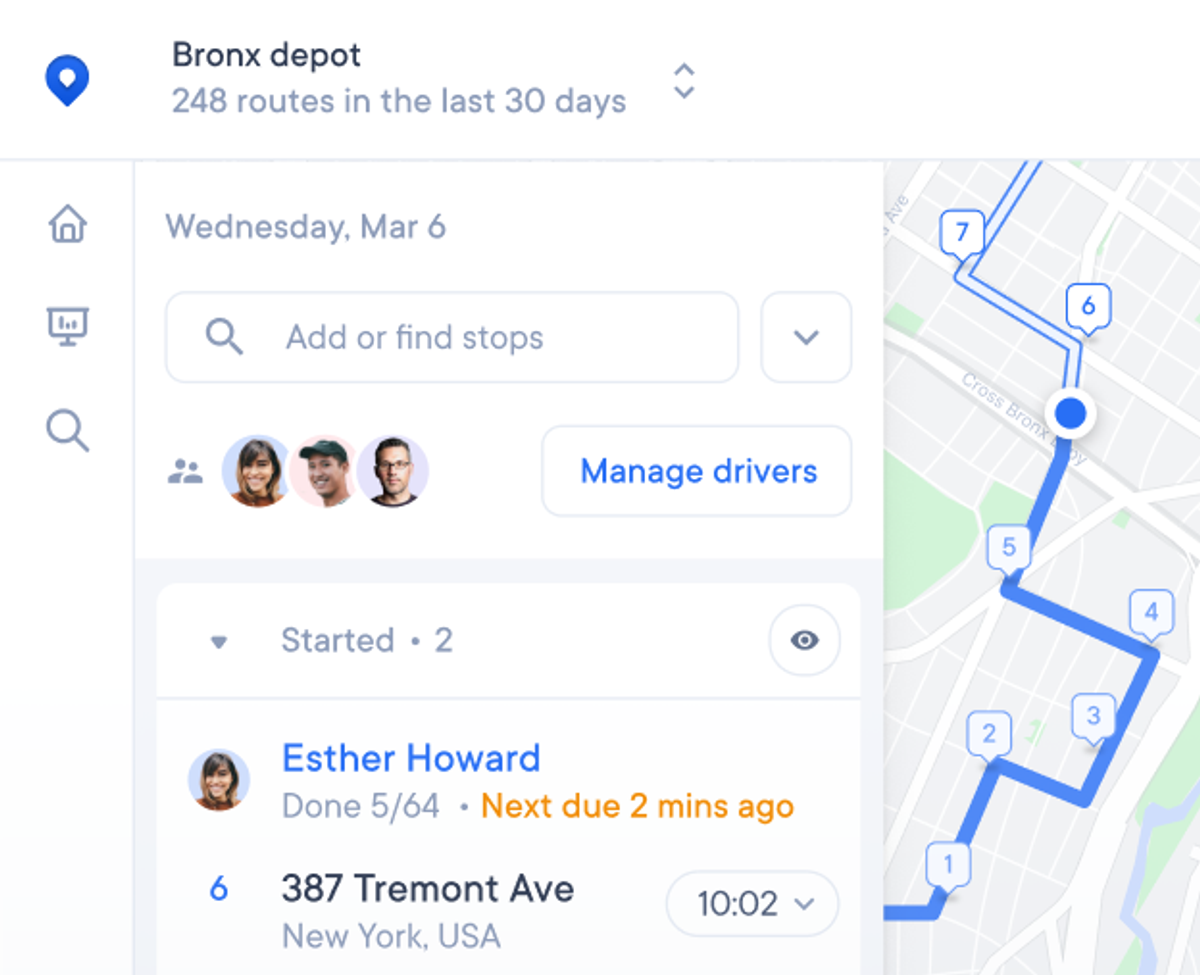
Throughout the day, you can edit live routes on the map, with changes appearing in the driver’s app straight away. Drivers navigate with Google Maps, Apple Maps or Waze, scan address labels and add stops mid-route.
Every stop is recorded with a photo, signature, barcode scan, geotag and timestamp, and failed attempts are logged alongside why they failed. Recipients get texts and emails with a branded tracking page and live ETA, with quiet hours you control.
At the end of the day, you get a report that shows success rates, stop volumes and failed delivery reasons per driver, which is all ready to export to CSV.
If you'd like to swap the spreadsheet and the constantly-ringing phone for one screen, you can start your free 7-day trial of Spoke Dispatch. Load up tomorrow's stops, cut your routes, and see how different those 10am curveballs feel.
FAQ
Dispatch management is the work of deciding which driver takes which stops, in what order, and then keeping that plan alive through the day as things change. For a courier company it covers cutting each day's stops into routes, assigning drivers, handling exceptions live, and keeping clients and recipients informed.
Dispatching is sending a person or vehicle to complete a job. In a courier business the job is a full route of stops rather than a single visit, so dispatching also means planning the order of stops, tracking progress, and reassigning work when a driver or a stop falls through.
A dispatch management system puts every client's stops in one place, cuts them into balanced routes, assigns them to drivers, shows where every driver is, pushes changes to the driver's phone, captures proof at the door, and automatically notifies recipients. It replaces the spreadsheet, the group chat and most of the phone calls, but the dispatcher still makes all the judgment calls.
Route planning is one step of dispatch management: working out the best order of stops for a driver. Dispatch management also covers assigning drivers, handling changes during the day, proof of delivery, and communication with drivers, clients and recipients.
It depends more on tooling than on headcount. Working from a spreadsheet and a group chat, one dispatcher is usually stretched by 10 to 15 drivers or a second client. With a dispatch management system that handles routing, live tracking and notifications, one dispatcher can run 30 or more drivers across several clients.