Most courier companies start out lean. A founder, a dispatcher, a handful of drivers, and a few spreadsheets. It works well in the early days. But once the business reaches around ten to fifteen drivers the entire operation becomes difficult to scale. More volume brings more exceptions. More exceptions expose the limits of manual processes. And what looked like a straightforward delivery workflow starts breaking in ways that cost time, money, and customer trust.
A scalable last mile strategy is not about adding more drivers or buying more vans. It is about building the systems that keep your operation predictable when the work increases. Courier companies that grow past fifteen drivers do it because they reduce operational chaos and replace guesswork with visibility, structure, and repeatable processes.
This guide outlines the systems that support growth and what a modern last mile strategy looks like for courier companies in 2025.
Why many courier companies struggle to scale
Operational chaos multiplies as volume grows
When a courier company grows from five drivers to fifteen the workload does not simply triple. It becomes exponentially harder to coordinate. Routes overlap. Drivers call in with ad hoc issues. Retail clients request last minute additions. Without systems that structure the work the dispatcher becomes the bottleneck for the entire day.
Manual routing caps your throughput
Manual routing works at low volume but it fails under scale. It also creates dependency on a small number of people who know how to rebuild routes on the fly. When that person is unavailable the operation slows down. Even small inefficiencies compound over hundreds of stops and create higher fuel costs, late deliveries, and slower fulfilment.
Lack of visibility creates unnecessary firefighting
Once the fleet grows past eight to ten drivers the dispatcher can no longer rely on phone calls or guesswork to understand what is happening on the road. Without real time location data, route progress indicators, and early warning signals dispatchers are forced to react after a problem happens rather than before.
Inconsistent customer experience becomes a revenue risk
Retail clients want predictable service. When routes are inconsistent, proofs of delivery are incomplete, or drivers miss communication steps clients start to question the reliability of the service. Churn increases and margins decrease because the courier company has to compensate for mistakes that could have been avoided with systems.
Dependency on hero employees slows growth
Many courier companies have one dispatcher or operations manager who knows everything about the business. This person becomes the single point of failure. A scalable strategy reduces this dependency by creating structure, documentation, and clear workflows that anyone can execute.
The five pillars of a modern last mile strategy
To scale beyond fifteen drivers courier companies need a strategic foundation that does not rely on heroics. These five pillars shape the most successful courier operations today.
1 - Route planning and automation
Route planning is the central strategic lever in a courier company. When routing is inconsistent the entire downstream workflow becomes unpredictable. Modern courier teams automate the bulk of routing so the dispatcher can focus on exceptions, not spreadsheets. Automation allows you to plan routes based on capacity, location clusters, delivery types, and performance data. This reduces both the cognitive load on the dispatcher and the operational risk created by manual planning.
The strategic impact is clear. Faster route planning leads to faster departures. Balanced workloads improve driver morale. More efficient routing reduces mileage and protects margins. Automation becomes the foundation for every other strategic system.
2 - Tracking and visibility
A courier strategy is only as strong as the visibility that supports it. Real time tracking gives dispatchers a live operational picture rather than an educated guess. It also creates the conditions for proactive decision making. If a driver falls behind you can redistribute stops before customers feel the delay. If a route becomes overloaded you can shift work early in the day. Visibility turns dispatching from a reactive role into an operational control function.
Visibility also reduces the volume of inbound calls from clients who want updates. Most courier companies underestimate how much time they lose each day answering status questions that could have been automated or resolved by a customer portal.
3 - Proof of delivery and accountability
Proof of delivery is more than a compliance box. It is a strategic tool that protects revenue and builds trust. High performing courier companies treat POD as part of their brand. Clean photos, signatures when needed, and clear notes reduce disputes, speed up invoicing, and give retail clients confidence in their service provider.
At scale consistent POD is only achievable with a structured workflow inside the driver app. This ensures every driver follows the same process regardless of experience or language proficiency.
4 - Customer communication
A strong last mile strategy includes predictable communication touchpoints. Customers expect to know when a driver is on the way, when a delivery is approaching, and when it has been completed. Automated notifications reduce manual work for dispatchers, decrease failed delivery attempts, and improve customer satisfaction. For retail clients this level of communication becomes a competitive differentiator. It signals that your courier company is reliable and systemised, not ad hoc and reactive.
5 - Analytics for operational intelligence
Analytics are the final pillar because they turn raw delivery activity into strategic insight. Most courier companies collect data but do not use it effectively. High performing teams look at stop duration, first attempt success rates, route performance, driver consistency, depot throughput, and margin per contract. They use these metrics to spot operational friction early and reshape their workflows. Analytics also support pricing decisions, staffing decisions, and driver coaching. When used correctly analytics help courier companies scale without losing control of the operation.
What high performing courier teams do differently
Many courier companies believe they need more drivers to grow, but high performing courier teams know that the real constraint is the system, not the headcount. The companies that scale reliably share several operational traits.
They balance workloads before departure
Uneven workloads create stress for drivers and additional labour costs for the business. High performing teams use tools that show estimated route duration before the vans leave the depot. This allows them to rebalance the day and prevent failures before they happen.
They maintain strict SLA discipline
Successful courier companies define their service level agreements clearly and build workflows that protect those commitments. They monitor early, late, and on time deliveries. They review exceptions quickly. They ensure retail clients get consistent performance even when the workload spikes.
They standardise workflows
Standard operating procedures do not remove flexibility. They create predictability. Courier companies that scale have clear steps for depot loading, route assignment, delivery checks, POD collection, and issue handling. This reduces training time for new drivers and removes inconsistency across the fleet.
They focus heavily on driver reliability and support
Driver performance is directly influenced by workload balance, routing quality, clear communication, and a simple driver app. Courier companies that scale do not rely on punitive management. They create an environment where drivers can succeed, because reliable drivers create reliable routes.
They build a minimum viable tech stack
High performing courier companies use a lean but integrated stack. They have route optimisation, real time tracking, POD workflows, notifications, and analytics. They avoid stitching together four or five mismatched tools that create more work than they remove. Their tech stack supports the operation instead of complicating it.
How to build the tech layer of your last mile strategy
A strategic last mile operation needs a tech layer that reflects how courier companies actually work. These are the core components.
The route optimisation engine
This is the heart of the system. It creates the daily plan, balances workloads, reduces mileage, and ensures drivers start the day with a clear route. A strong optimisation engine saves hours of manual routing time and improves service reliability.
The driver app
Drivers need clear instructions, accurate turn by turn navigation, POD workflows, and the ability to send updates without calling the dispatcher. A simple driver app reduces training time, prevents errors, and supports drivers who speak different languages.
The dispatcher dashboard
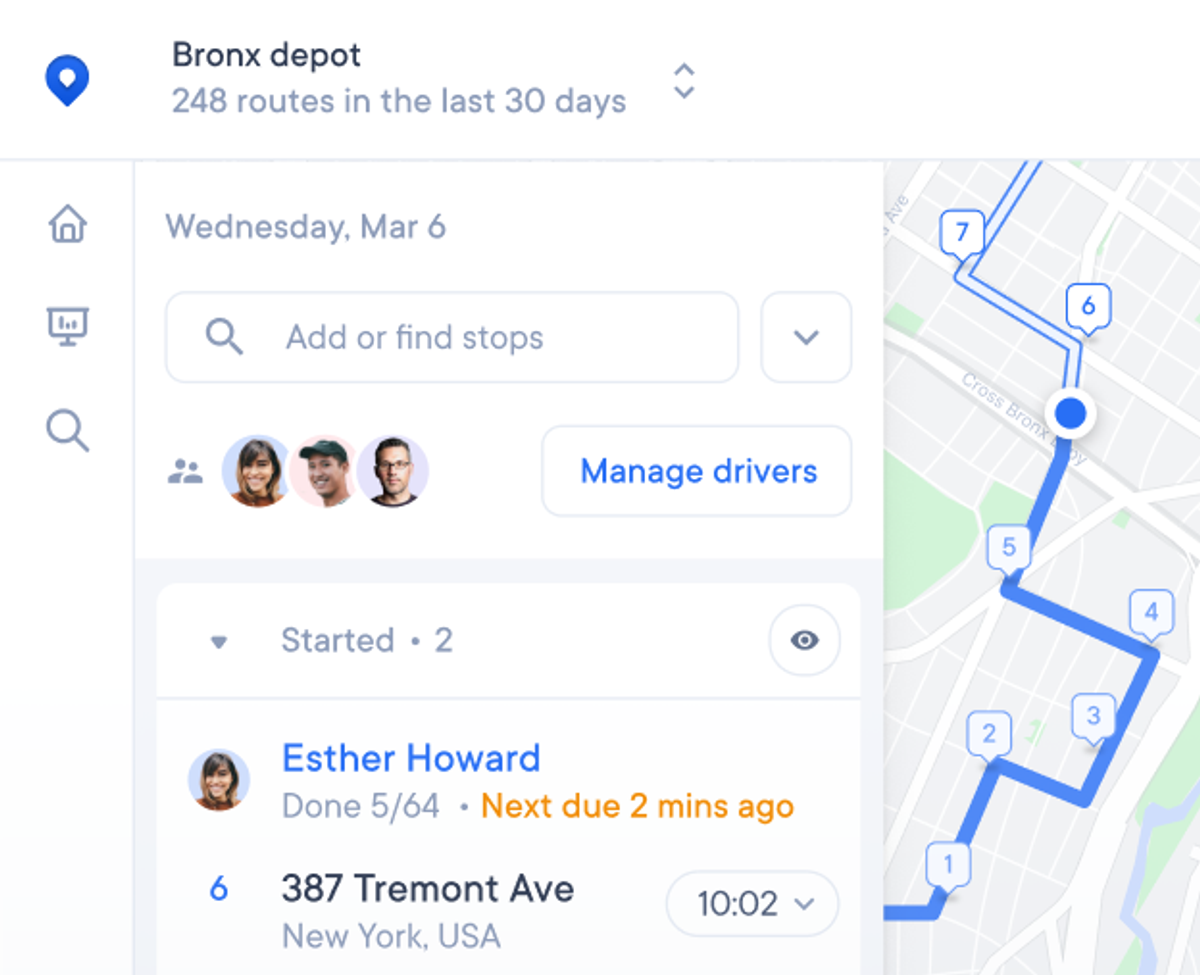
The dispatcher needs a single control center. This includes a view of all routes, real time locations, progress indicators, delay alerts, and tools to reshuffle stops. A dispatcher should not have to jump between multiple systems to understand what is happening.
Proof of delivery workflows
POD should be consistent across all drivers. That includes photo capture, signature options, barcode or QR scanning when required, and space for notes. The workflow must be simple enough that every driver can follow it under pressure.
The depot to route to POD loop
Courier operations follow a predictable flow. Freight arrives at the depot. Drivers load their vans. Routes are executed. POD is collected. Retail clients are updated. The tech stack must support this entire loop, not just one part of it.
Two way API integrations
As courier companies grow they need tighter integration with retail clients, order management systems, and back office tools. Two way API connections reduce manual file processing and remove the friction that slows down the last mile. They also create more accurate handoffs between systems.
When couriers adopt last mile management software
Courier companies usually adopt last mile management software when they reach a breaking point. This tends to happen between five and fifteen drivers depending on the complexity of the work.
The breaking point
The dispatcher becomes overwhelmed. Routes take too long to build. Exceptions increase. Clients start noticing inconsistencies. Drivers complain about workload imbalance or unclear instructions. The business can feel busy but still lose money because inefficiencies are hidden until the end of the week.
Signs your system is failing
Here’s some signs your system is failing:
- You rely on spreadsheets for routing.
- You get more inbound calls than you can answer.
- Drivers take longer at stops and you do not know why.
- Retail clients ask repeatedly for delivery updates.
- You have no clear view of driver performance.
- Late deliveries increase but you cannot pinpoint the cause.
These are all indicators that the operation needs formal systems.
Real world examples
The courier companies that scale reliably usually say the same thing. They reached a point where manual processes could no longer support the workload. Once they added automation, tracking, POD structure, and analytics the operation became calmer and more predictable. They could accept more work without burning out the team.
Courier growth requires systems, not more drivers
Most courier companies do not fail because of lack of demand. They struggle because the operation becomes too complex to manage manually. A strong last mile strategy gives courier teams the visibility, structure, and predictability they need to scale confidently. With the right systems in place the business becomes easier to manage and far easier to grow.