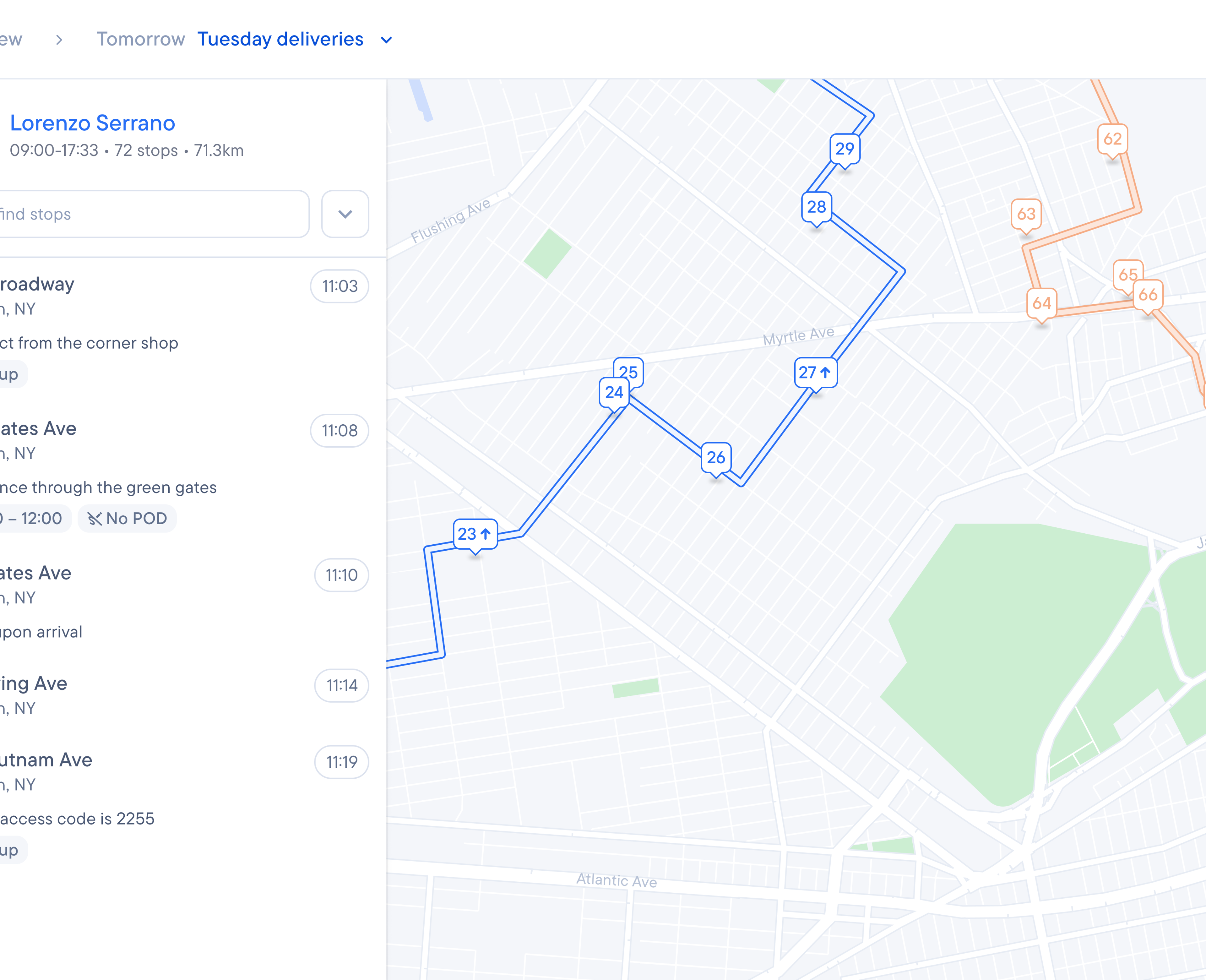
Choosing the right alternative to Onfleet depends on more than route quality. For courier companies managing commercial delivery contracts, the dispatcher's day-to-day work extends well beyond planning an efficient route.
Managing deliveries for multiple shipper accounts means juggling different proof requirements, exception handling, and billing cycles for each one. Last mile couriers need the flexibility of custom fields per client, POD capture in whatever format they expect, and live visibility so they're not calling for status updates.
Some platforms were designed specifically for this kind of work. Others were built for route planning, field service, retail delivery, or scheduled big-ticket delivery - and can still work for certain courier companies depending on their size and operating requirements.
This comparison covers six platforms: Spoke Dispatch and five Onfleet alternatives. Each is evaluated on four questions: whether it handles only the route or the work around the route, how pricing changes as volume and driver count grow, how much shipper complexity it can absorb, and where the platform stays strongest on its own terms. Spoke Dispatch is included alongside the five alternatives, with its genuine limitations stated.
Pricing comes from each company's published pricing page where available, and from third-party review sites (Capterra, GetApp, TrustRadius) where it isn't. Costs are compared at courier-relevant volumes: 2,000, 5,000, and 10,000 stops per month. Review ratings are from G2 and Capterra as noted and should be rechecked before publication.
Why courier operators leave Onfleet
Onfleet is a polished, highly rated delivery management software - worth stating before evaluating alternatives. The driver app earns consistently strong marks across iOS and Android. Route optimization, tracking, and recipient notifications work well. Onfleet carries 4.6/5 across 140 G2 reviews and 4.6/5 across 95 Capterra reviews.
Courier companies start evaluating alternatives when the pricing math stops making sense for how they operate. The Launch plan is $619 per month for 2,500 tasks - up from $500 as recently as 2024. Barcode scanning, auto-dispatch, and the Command Center dashboard require the Scale plan at $1,349 per month. The Courier Suite - client portal, rate tables, invoicing, and driver pay - costs another $299 per month on top. SMS and telephony are billed separately. A courier company that needs barcode scanning and the Courier Suite is looking at $1,648 per month before any message charges.
The Courier Suite tells the story most clearly. A client portal, rate tables, and invoicing are foundational requirements for a courier company managing commercial accounts - not premium add-ons. The features that make Onfleet courier-ready arrive as a paid bolt-on rather than core product, which is the structural point: courier work sits at the edge of Onfleet's product and pricing model, not at the center.
Here are the six platforms worth comparing.
Platform comparison
Each platform below is evaluated on the same four questions from the introduction. The "Best for" label names a concrete operation type - not a ranking.
Platform | Rating | Key courier features | Entry price | Best for |
|---|---|---|---|---|
Spoke Dispatch | 4.8/5, 105 reviews (Capterra) | Address flagging, client portal, per-client POD, barcode custody trail | From $125/mo (stop-based, unlimited drivers) | Growing courier companies with 5+ drivers managing multiple accounts |
Routific | 4.8/5, 46 reviews (G2) | Route optimization, route balancing, Shopify/ and Magento integrations | From $150/mo (per-order) | Courier teams with 5 or fewer drivers whose bottleneck is route quality |
OptimoRoute | 4.8/5, 53 reviews (G2) | POD with photo, signature and barcode capture, offline-capable app | From $39/driver/mo (Lite) | Budget route planning for small courier teams |
Route4Me | 4.7/5, 125 reviews (G2) | Geofencing audit trail, scan-to-load depot verification, dynamic re-routing | From ~$40/user/mo (pricing not published) | Courier or field-service teams with mixed delivery and field jobs |
eLogii | 4.8/5, 5 reviews (G2) | Rate cards for 3PLs, cash on delivery, multi-depot deep configuration | From $575/mo (quote-based) | Enterprise delivery operations needing extensive routing configuration |
DispatchTrack | 4.5/5, 13 reviews (G2) | AI routing, Driver AI voice briefings, customer self-scheduling | From ~$75/vehicle/mo (quote-based, annual) | Retailers running scheduled big-ticket deliveries with crews and installs |
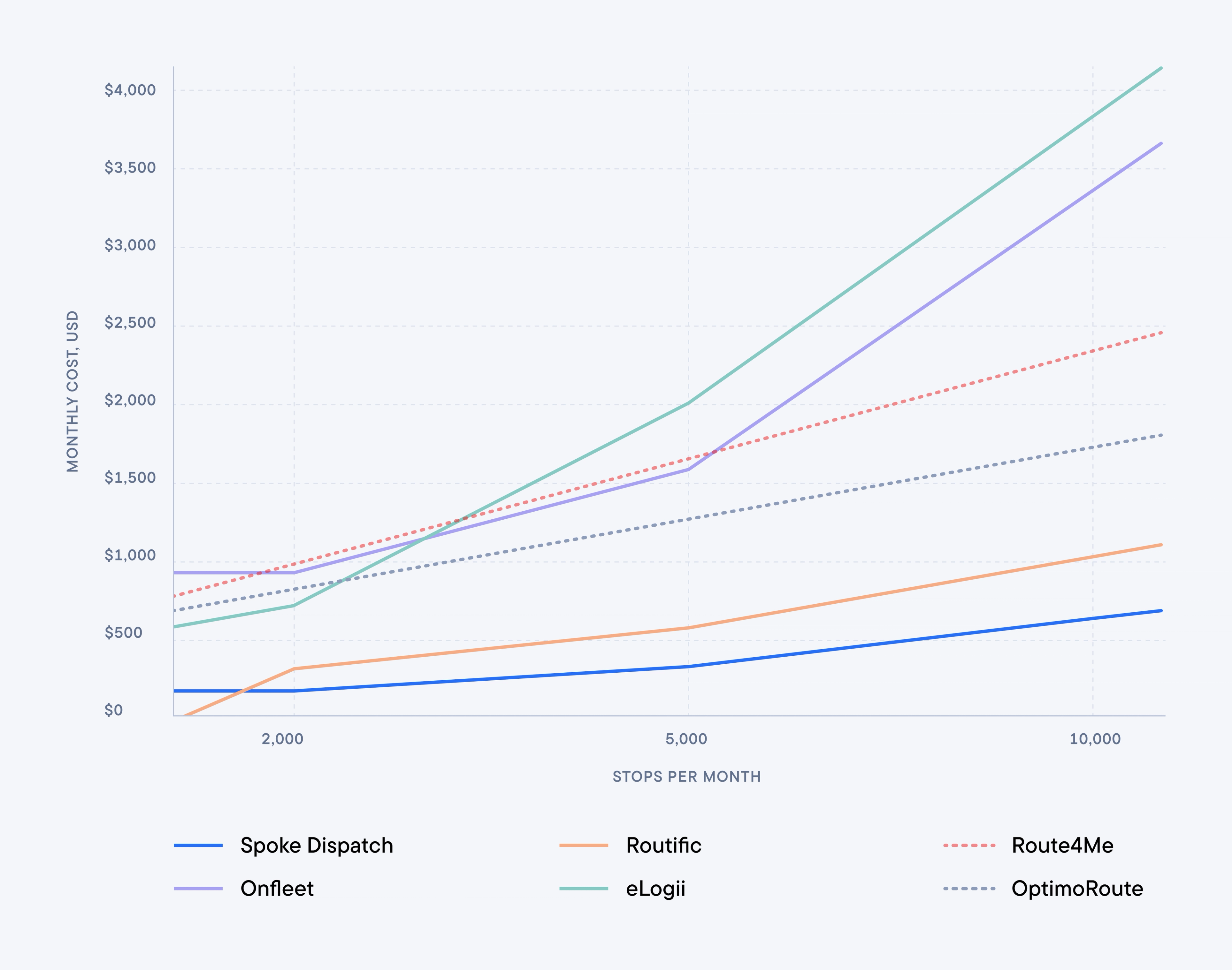
Here’s a cost per stop price comparison for the Onfleet alternatives on this list.
What each platform costs at courier stop volumes
The comparison table shows first-pass fit: what each platform does well, where it starts, and which courier profile it best serves. The cost table below answers a different question: what happens when that fit meets real courier volume.
That distinction matters because entry price can hide the operating economics. A route planner can look inexpensive for five drivers and expensive for 25. A task-tiered delivery platform can look manageable until barcode scanning, analytics, or a client portal moves the courier into a higher tier. A stop-based platform can look more expensive than a per-driver tool at one fleet size and less expensive once the courier adds drivers without changing monthly stop volume.
Courier companies should also compare pricing against the way revenue is earned. If revenue is tied to completed deliveries, software that prices by stop or task can track the business model more closely. If pricing is tied to driver count, the bill can rise when a courier adds backup drivers, seasonal contractors, or part-time coverage, even before delivery volume rises. If pricing is quote-based, the headline number may not include implementation, integrations, SMS, geofencing, or customer-facing workflows. The same shortlist can change once volume is modeled.
Use the next table as an operating-cost check, not a precise quote. The goal is to compare pricing model behavior at realistic courier volumes: how the bill changes when the same business moves from roughly 2,000 stops to 5,000 or 10,000 stops per month.
Platform | Pricing model | ~2,000 stops/mo | ~5,000 stops/mo | ~10,000 stops/mo |
|---|---|---|---|---|
Spoke Dispatch | Per-stop, unlimited drivers | $125-200 | $380-1,000 | ~$1,000 |
Onfleet | Per-task tiers | $619 | $1,349 | $3,099+ |
Onfleet + Courier Suite | Above + $299/mo | $918 | $1,648 | $3,398+ |
Routific | Per-order, volume discounts | ~$300 | ~$700 | ~$934 |
OptimoRoute (Pro) | Per-driver ($49/driver) | ~$490 (10 drivers) | ~$490-980 | ~$980-2,450 |
Route4Me | Per-user plus add-ons | ~$600-900 | ~$900-1,800 | ~$1,800+ |
eLogii | Per-task tiers (quote-based) | $575 | $1,999 | $1,999-3,999 |
DispatchTrack | Per-vehicle, annual contract | Quote-based | Quote-based | Quote-based |
Estimates assume approximately 40 stops per driver per day and 22 working days per month. Per-driver platforms are shown at representative fleet sizes. Spoke and Onfleet pricing comes from their published pricing pages. Routific pricing comes from its pricing page. eLogii and Route4Me figures come from third-party review sites (Capterra, GetApp) and are approximate. DispatchTrack requires a sales conversation.
The key model distinction: per-stop pricing (Spoke Dispatch) means growing your fleet doesn't change your software cost. Per-driver pricing (OptimoRoute, Route4Me) bills for roster size whether the month is light or heavy. Per-task pricing (Onfleet, eLogii) bills for delivery volume, at tier thresholds that courier operations can exceed quickly.
For a concrete example: a 10-driver courier running approximately 8,800 stops per month pays $490/month on OptimoRoute Pro. On Spoke Dispatch Premium, the same volume costs roughly $608/month ($200 base plus $0.06 per overage stop). The entry price difference is manageable. At 20 drivers running the same total stop volume, OptimoRoute doubles to $980/month while Spoke Dispatch's bill stays near $608. That gap widens further when a courier adds backup drivers, seasonal contractors, or part-time coverage before delivery volume changes.
Here is what each platform delivers for that cost.
1. Spoke Dispatch - the courier-first platform
Spoke Dispatch is built specifically for the last mile courier operating model - pricing, features, and roadmap are calibrated for it. Because the product roadmap doesn't split across restaurants, retailers, and couriers, every feature decision prioritizes courier workflows.
Stop-based pricing starts at $125/month for 1,000 stops, with unlimited drivers on every plan. The Premium plan at $200/month (2,000 stops) is labeled "Best for couriers" on the pricing page. Expert at $1,000/month covers 12,000 stops with five years of data history.
Spoke Dispatch ships route-quality controls around address and map accuracy. . It can flag incorrect or unclear addresses before they disrupt routes, let dispatchers pin stops directly on the map, and give drivers Google Maps navigation inside the Spoke driver app, so they're not switching between two apps to complete a route. That matters because an unflagged address can stall a driver mid-route - exactly when the dispatcher is already managing live exceptions.
The Connect client portal addresses the multiple-shipper-account workflow directly. Courier companies invite retail clients into a shared platform where they can upload delivery stops, track shipments in real time, and resolve disputes without calling or emailing for updates. IncaPost, an Australian courier handling bulky items, saves 15 minutes per route on data management through Connect. RoadRunner, an Australian fleet management company, describes the competitive advantage Spoke provides this way:
"Lots of clients are still very old school in terms of their tech systems. No ETAs, no ability to track the drivers. POD that they can't access for hours or even until the next day! It's just old and clunky, so by using Spoke Dispatch, we definitely have the advantage."

Proof-of-custody timestamps give dispatchers a more specific answer when a shipper asks where a package is. Packages with barcodes can be scanned when they are added to a route, loaded onto a vehicle, and attempted for delivery, creating a custody trail that recipients can also see from the tracking link.
Before deciding, note the tradeoffs. The Starter plan limits data history to 30 days - a delivery completed on day one of the month isn't accessible for dispute resolution by day 35. The Premium plan gives one year of history; Expert gives five. Courier companies with healthcare, pharmacy, or other compliance-sensitive contracts should verify current security and certification requirements directly before choosing any platform.
2. Routific
Best for courier teams with 5 or fewer drivers focused on route quality.
Routific's core strength is route optimization. The platform says it uses 179 machine learning models for traffic-aware routing and balances routes by shift time or order count. No feature gating means every capability is available at every price tier - a structural advantage most competitors can't match.
Pricing moved from per-vehicle to per-order in mid-2024. The free tier covers 100 orders per month. The $150/month flat rate covers up to 1,000 orders, with volume discounts above that. Native integrations with Shopify, WooCommerce, and Magento give courier companies a practical starting point for pulling orders from retail clients' e-commerce platforms.
Reviewers on G2 describe the routing as flexible and accurate, with clean route clustering and the ability to adjust quickly as conditions change during the day.
The platform's limits are visible in two daily moments. When a shipper asks where a specific parcel is, the dispatcher has to call the driver, get the answer, and relay it back - there's no client-facing portal for self-serve status checks. At end of day, when a delivery is disputed and the courier needs visual proof, the single-image POD cap may not cover what the shipper expects: a package photo and an invoice photo as separate documentation files.
The driver app is a specific area to test during evaluation. Routific relies on third-party navigation (Google Maps, Waze) rather than native turn-by-turn directions. No dispatcher-driver chat. No geofencing. No return or reverse logistics workflows. SMS notifications are a paid add-on. Routes cap at 500 stops. Analytics are end-of-day statistics, not live updates.
Routific handles routing well for courier teams where route quality is the main constraint. The management layer around routing - proof documentation, client visibility, exception handling, and multi-account reporting - is where teams managing multiple shipper accounts will need more. The free tier is genuinely low-risk to evaluate for operations with contained requirements.
3. OptimoRoute
Best budget route planning for small courier teams with simple shipper requirements
OptimoRoute is the most affordable option on this list for small courier teams. The Pro plan at $49 per driver per month includes route optimization, proof of delivery, customer notifications, and analytics. The 30-day free trial - the most generous on this list - applies to full Pro features.
The driver app works in areas with limited connectivity. Barcode and QR scanning for delivery confirmation is included at the Pro tier. Workload balancing distributes stops by hours worked or order count. Operations manager reviewers on G2 describe the platform as essential to their daily route planning - consistently more efficient than manual routing.
Per-driver pricing is where the courier-fit question sharpens. At 10 drivers on Pro, the bill is $490/month. At 20 drivers, $980/month. At 50 drivers, $2,450/month - regardless of how many stops each driver runs that month. The billing model charges for roster size, not delivery volume, so a slow month costs the same as a peak month.
Multi-shipper billing is where small courier teams hit the operational ceiling. OptimoRoute delivers routing and proof of completion. The billing reconstruction - matching completed stops to contracted rates per shipper account, then generating invoices - happens outside the platform, in spreadsheets, after the dispatcher's day is supposed to be done.
On the Lite plan ($39/driver), there's route optimization and live tracking but no POD capture, customer notifications, or analytics. Pickup-and-delivery routing is in beta and available only on the Custom plan. The API caps at five concurrent requests.
For courier companies under 20 drivers working primarily with one anchor client or a small number of shippers, OptimoRoute's 30-day trial is worth running. The platform fits well when route quality is the primary need and billing complexity is low. When fleet size grows or multiple shipper accounts each require separate proof documentation and billing, the platform stops where courier operations management starts.
4. Route4Me
Best for field-service and delivery businesses running mixed work types
Route4Me serves courier, field service, sales, pest control, and waste management operations from the same platform. That breadth is a genuine advantage for businesses running delivery alongside other field work. For courier companies running dedicated parcel dispatch, the pricing adds up fast.
Route4Me doesn't publish pricing. Third-party review sites report plans from $40/user/month for route management (no optimization included) to $90/user/month for Business Optimization, with a five-user minimum. Those are base costs: SMS notifications add $20/user/month, geofencing adds $5/user/month, recurring routing is a paid add-on. The customer portal and e-commerce integrations require Enterprise pricing through a sales conversation. A 20-driver courier on Business Optimization with SMS and geofencing reaches approximately $2,300/month.
The platform has real strengths. Territory management with SmartZone clustering handles delivery zones. The driver app works across iOS, Android, and Zebra devices with offline mode and automatic sync. Barcode scan-to-load confirms packages are on the right vehicle before drivers leave the depot. Dynamic re-optimization lets dispatchers adjust routes after drivers are already on the road.
Package and freight delivery reviewers on G2 point to the time savings from importing stop lists and generating routes in a single step - hours saved per day on manual planning.
Route quality issues appear consistently: overlapping routes sending multiple drivers to the same area, unnecessary backtracking, and address imports that slow down noticeably with large stop counts.
Route4Me works for businesses that run deliveries alongside field service operations and want one platform for both. For courier companies running high-volume parcel dispatch with dedicated drivers, the add-on costs accumulate quickly for features that courier-focused platforms include at the base price.
5. eLogii
Best for enterprise delivery operations needing deep configuration
eLogii has the deepest configuration on this list. Hundreds of parameters covering driver skills, vehicle types, delivery zones, POD workflows, and optimization priorities. Multiple optimization engines. Cash-on-delivery reconciliation workflows. ML-enhanced ETAs that improve over time.
Third-party sources (Capterra, GetApp) report a Starter plan at $575/month for 2,500 tasks, Premium at $1,999/month for 8,500 tasks, Professional at $3,999/month for 40,000 tasks. eLogii's website shows no pricing and requires a quote for all tiers. All plans include unlimited drivers.
Feature gating is sharp. Analytics require the Professional tier at $3,999/month. Webhooks are also Professional-only. Barcode scanning through the driver app requires Premium at $1,999/month. A courier on the Starter plan at $575/month gets 2,500 tasks with no analytics, no webhooks, and no barcode scanning. Many courier operations exceed 2,500 stops in a single week.
One CIO reviewing on G2 describes eLogii as highly flexible with fast, effective route optimization and a broad API - and also flags the limited user roles (admin, full access, or viewer) and the consistent pattern of key features requiring a higher tier.
Configuration depth is also overhead. When a client spreadsheet arrives at 7am with revised stop sequences, access notes, and updated time windows, mapping those details through hundreds of parameters takes time. For a dispatcher who's also handling driver questions, exception calls, and live re-optimization requests, that setup competes directly with the morning's live dispatch work.
Analytics update once per day, not in real time. The driver app is consistently flagged in reviews as needing improvement.
eLogii fits operations with complex vehicle constraints, driver skill matching, and multi-zone routing - and the budget to reach the tiers where the platform's depth is accessible. For a growing regional courier running 15 to 50 vehicles, the configuration overhead is more than most dispatch teams can absorb in stride.
6. DispatchTrack
Best for large retailers and distributors running scheduled big-ticket deliveries
DispatchTrack is enterprise last mile delivery software for large retailers and distributors. Walmart, Ashley, Coca-Cola, and Ferguson Enterprises are on the customer list. The operational model is scheduled appointment-window delivery with crews: fewer stops per driver, larger items, installation workflows, and structured client communication requirements. That's a different job from multi-stop parcel dispatch.
DispatchTrack claims 98% ETA accuracy for AI-powered routing and reports more than one million deliveries per day across 2,500+ customers. Driver AI plays a 30-second audio briefing before each stop, covering access instructions, parking details, and customer-specific notes. Customers can self-schedule and reschedule through automated notifications. SAP and NetSuite integrations connect to enterprise ERP systems.
Customer service managers in mid-market enterprises on G2 describe significant operational improvements: shared team visibility, cloud photo storage for field documentation, and access for multiple team members at no additional charge.
Pricing is not public. TrustRadius reports $75 per vehicle per month for planned and dynamic delivery plans, but real costs include annual contract minimums, implementation fees, and integration work. No self-serve trial - demos only.
Documented weaknesses map to courier requirements. The mobile app is described as outdated across reviews. Reporting is the most common criticism: limited scope, not easily customizable, and not built for daily operational use. Real-time route flexibility requires manual workarounds rather than native re-optimization. Multi-user dispatch was designed around a single-dispatcher model and creates consistency problems when several dispatchers share the same workload. The integration list covers 11 named systems - all enterprise-weighted, with no Shopify, WooCommerce, or Zapier for courier companies connecting to retail clients' order systems.
DispatchTrack is well-designed for scheduled bulk delivery operations. Courier companies running multi-stop parcel dispatch will find a better fit elsewhere on this list.
Two Onfleet alternatives ruled out for courier operations
Tookan and Bringg appear in most Onfleet comparison articles. Both are worth a brief evaluation, both fall short for courier-specific work.
Tookan
Tookan is a Jungleworks product serving small businesses across food delivery, e-commerce, retail, and last mile couriers. Pricing starts at $39/month and scales by task volume. Strengths include 150+ integrations, customizable task workflows and a competitive entry price for on-demand and hyperlocal delivery operations.
The case for ruling it out: Tookan's product direction has drifted toward general-purpose dispatch rather than courier-specific depth. Recent Capterra reviews flag misleading sales claims about WooCommerce integration features that don't actually exist. White-label branding sits behind a separate paid tier. For courier companies managing multi-shipper accounts with rate cards and client portals, Tookan stops well short of the operational layer required.
Bringg
Bringg is enterprise last mile orchestration software for retailers and logistics providers. The customer list includes Coca-Cola and Walmart. Strong omnichannel fulfillment, multi-carrier routing across internal and external fleets, returns management, and extensive API capabilities.
The case for ruling it out: Bringg's pricing model starts at $150-300 per driver per month with implementation fees from $50,000 to $100,000 and 3-6 month onboarding timelines. The platform is engineered for retailers coordinating dispatch across multiple carriers, not for actual courier companies running their own fleets. Mid-market reviewers consistently describe Bringg as over-engineered for non-enterprise operations.
Choosing the right Onfleet alternative for your courier operation
The right platform depends on the gap that matters most.
If you're a growing courier company with 5+ active drivers that needs full operational management beyond routing - driver management, POD per shipper, client portals, multi-account analytics, and billing support - Spoke Dispatch is built specifically for this operating model. Stop-based pricing means adding drivers doesn't raise your software cost the way per-driver platforms do.
If you're under 5 drivers and route optimization is the primary need - no client portal, no multi-shipper billing, no dispatcher-driver communication - Routific or OptimoRoute both deliver strong routing at lower entry points. Routific's free tier (100 orders/month) and OptimoRoute's 30-day trial make both genuinely low-risk to evaluate. Choose Routific if you want all features at every price tier. Choose OptimoRoute if per-driver pricing works at your current fleet size and you want the longest trial period.
If you run field service alongside delivery and need one platform for both, Route4Me covers both use cases. Factor the add-on costs - SMS, geofencing, and e-commerce integrations - into your total before comparing against courier-specific platforms.
If your operation runs 50+ vehicles with complex vehicle, zone, and driver-skill routing requirements, eLogii's configuration depth is genuine. Confirm that the analytics and integration features you need are on the tier you're buying, not the tier above.
If your business is scheduled big-ticket delivery for large retailers - furniture drops, appliance installations, building materials with appointment windows - DispatchTrack was purpose-built for that operational model. Courier companies running multi-stop parcel dispatch will find a better fit here.
If cost is the primary constraint and you're under 10 drivers, OptimoRoute Lite ($39/driver/month) or Routific's free tier get you optimized routes with the lowest upfront commitment.
If your courier operation is outgrowing its current tools, Spoke Dispatch has a 7-day free trial with no credit card required. From $125/month with unlimited drivers.
Onfleet's Launch plan starts at $619 per month for 2,500 tasks. The Scale plan is $1,349 per month for 5,000 tasks. Enterprise starts at $3,099 per month for 10,000+ tasks. The Courier Suite - client portal, rate tables, invoicing, and driver pay - adds $299 per month. SMS and telephony are billed separately. Onfleet offers a 14-day free trial with unrestricted access to your chosen plan.
The best alternative depends on operation size and daily requirements. For growing courier companies with 5+ active drivers that need full operational management beyond routing - POD per shipper, client portals, multi-account analytics - Spoke Dispatch is built specifically for this operating model. For teams under 5 drivers focused primarily on route quality, Routific and OptimoRoute offer strong routing at lower entry points. The comparison table above gives a side-by-side starting point.
Not at current pricing. The Launch plan is $619/month minimum, with barcode scanning and auto-dispatch gated behind the Scale plan at $1,349/month. Lower-cost options include Routific (free tier at 100 orders/month), OptimoRoute Lite ($39/driver/month), and Spoke Dispatch ($125/month with unlimited drivers).
Three consistent issues: the entry price is $619/month minimum, with courier-specific features gated behind higher plans; the Courier Suite - client portal, invoicing, and rate management - costs an additional $299/month rather than being included in the base product; and the platform's broad delivery market scope means product development priorities compete across multiple verticals rather than focusing on courier requirements.
No. Route planning stays essential. What changes is that routing becomes one part of a broader operating system: client portals, proof requirements by shipper, billing support, exception handling, and live visibility.